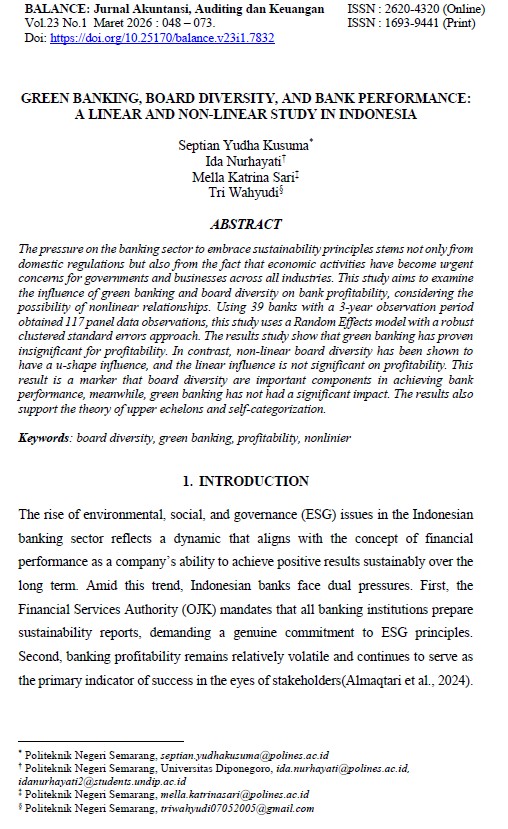
GREEN BANKING, BOARD DIVERSITY, AND BANK PERFORMANCE: A LINIEAR AND NON-LINEAR STUDY IN INDONESIA
DOI:
https://doi.org/10.25170/balance.v23i1.7832Keywords:
board diversity, green banking, profitability, nonlinierAbstract
The pressure on the banking sector to embrace sustainability principles stems not only from domestic regulations but also from the fact that economic activities have become urgent concerns for governments and businesses across all industries. This study aims to examine the influence of green banking and board diversity on bank profitability, considering the possibility of nonlinear relationships. Using 39 banks with a 3-year observation period obtained 117 panel data observations, this study uses a Random Effects model with a robust clustered standard errors approach. The results study show that green banking has proven insignificant for profitability. In contrast, non-linear board diversity has been shown to have a u-shape influence, and the linear influence is not significant on profitability. This result is a marker that board diversity are important components in achieving bank performance, meanwhile, green banking has not had a significant impact. The results also support the theory of upper echelons and self-categorization
References
Aiken, L. S., West, S. G., & Reno, R. R. (1991). Multiple regression : Testing and interpreting interactions. Sage Publications.
Almaqtari, F. A., Elmashtawy, A., Farhan, N. H. S., Almasria, N. A., & Alhajri, A. (2024). The moderating effect of board gender diversity in the environmental sustainability and financial performance nexus. Discover Sustainability, 5(1), 318. https://doi.org/10.1007/s43621-024-00517-7
Alzayed, N., Batiz-Lazo, B., & Eskandari, R. (2024). Does board diversity mitigate risk? The effect of homophily and social ties on risk-taking in financial institutions. Research in International Business and Finance, 70, 102306. https://doi.org/10.1016/j.ribaf.2024.102306
Ararat, M., Aksu, M., & Tansel Cetin, A. (2015). How board diversity affects firm performance in emerging markets: Evidence on channels in controlled firms. Corporate Governance: An International Review, 23(2), 83–103. https://doi.org/10.1111/corg.12103
Asmara, M. Y. C., & Nugraeni, N. (2024). Pengaruh green banking dan efisiensi biaya operasional terhadap profitabilitas perbankan di Indonesia. Jurnal Ekuilnomi, 6(3), 571–579. https://doi.org/10.36985/9j5vjy17
Aureli, S., Brighi, P., & Schadewitz, H. (2026). The impact of board diversity and sustainability engagement on bank performance. Journal of Management and Governance. https://doi.org/10.1007/s10997-026-09778-y
Baltagi, B. H. (2005). Econometric analysis of panel data. J. Wiley & Sons.
Bhateja, F. (2025). Boardroom diversity and firm performance: Exploring the moderating role of strategic change in NIFTY 500 index companies. Corporate Governance: The International Journal of Business in Society. https://doi.org/10.1108/CG-02-2025-0115
Birindelli, G., Bonanno, G., Dell’Atti, S., & Iannuzzi, A. P. (2022). Climate change commitment, credit risk and the country’s environmental performance: Empirical evidence from a sample of international banks. Business Strategy and the Environment, 31(4), 1641–1655. https://doi.org/10.1002/bse.2974
Blau, P. M. (1977). Inequality and heterogeneity : A primitive theory of social structure. Free Press.
Chiaramonte, L., Dreassi, A., Girardone, C., & Piserà, S. (2022). Do ESG strategies enhance bank stability during financial turmoil? Evidence from Europe. The European Journal of Finance, 28(12), 1173–1211. https://doi.org/10.1080/1351847X.2021.1964556
de Moraes, C. O., Cunha, L. V., & Galvis-Ciro, J. C. (2024). Banking sustainability in a large emerging economy: Focus on Brazilian banks. Journal of Economics and Business, 132, 106207. https://doi.org/10.1016/j.jeconbus.2024.106207
European Banking Authority, & European Securities and Markets Authority. (2021). Final report on guidelines on the assessment of the suitability of members of the management body and key function holders (EBA/GL/2021/06, ESMA35-36-2319) AU - European Banking Authority.
Freeman, R. Edward. (2018). Strategic management : A stakeholder approach. Cambridge University Press.
Gharios, R., Awad, A. B., Abu Khalaf, B., & Seissian, L. A. (2024). The impact of board gender diversity on european firms’ performance: The moderating role of liquidity. Journal of Risk and Financial Management, 17(8), 359. https://doi.org/10.3390/jrfm17080359
Grishunin, S., Yarantseva, A., & Karminsky, A. (2024). Influence of gender and age diversity of boards on financial and market performance of banks. Procedia Computer Science, 242, 372–379. https://doi.org/10.1016/j.procs.2024.08.172
Guedes, M. J., & Grübler, A. S. (2025). Balanced gender boards and environmental, social, and governance performance. Risk Governance and Control: Financial Markets and Institutions, 15(1, special issue), 174. https://doi.org/10.22495/rgcv15i1sip3
Hambrick, D. C., & Mason, P. A. (1984). Upper echelons: The organization as a reflection of its top managers. The Academy of Management Review, 9(2), 193. https://doi.org/10.2307/258434
Han, Z., Xu, H., & Tu, K. (2019). Research on the effectiveness of green credit policy-based on the empirical study of 19 listed banks in China. 2019 3rd International Conference on Data Science and Business Analytics (ICDSBA), 202–205. https://doi.org/10.1109/ICDSBA48748.2019.00049
Hart, S. L. (1995). A natural-resource-based view of the firm. Academy of Management Review, 20(4), 986–1014. https://doi.org/10.5465/amr.1995.9512280033
Hausman, J. A. (1978). Specification tests in econometrics. Econometrica, 46(6), 1251. https://doi.org/10.2307/1913827
Hosny, K., & Elgharbawy, A. (2022). Board diversity and financial performance: Empirical evidence from the United Kingdom. Accounting Research Journal, 35(4), 561–580. https://doi.org/10.1108/ARJ-02-2020-0037
Inegbedion, H. (2024). Green banking and profitability of banks in Nigeria: Opinions and attitudes. Heliyon, 10(14), e34303. https://doi.org/10.1016/j.heliyon.2024.e34303
Insani, D. S., & Muflih, M. (2019). Determinants of Islamic bank performance: Evidence from Indonesian Islamic banking industry. IOP Conference Series: Materials Science and Engineering, 662(7), 072001. https://doi.org/10.1088/1757-899X/662/7/072001
Islam, M. T., Saha, S., & Rahman, M. (2025). Diversity–performance nexus in an emerging economy: An investigation of family and non-family firms. International Journal of Emerging Markets, 20(2), 887–912. https://doi.org/10.1108/IJOEM-04-2022-0727
Issa, A., Sahyouni, A., & Mateev, M. (2024). A path to success: Educational board diversity and its influence on MENA banks’ efficiency and stability. Corporate Governance: The International Journal of Business in Society, 24(6), 1283–1313. https://doi.org/10.1108/CG-08-2023-0339
Issa, A., Yousef, H., Bakry, A., Hanaysha, J. R., & Sahyouni, A. (2021). Does the board diversity impact bank performance in the MENA countries? A multilevel study. Corporate Governance: The International Journal of Business in Society, 21(5), 865–891. https://doi.org/10.1108/CG-06-2020-0222
Jain, P., & Sharma, B. K. (2023). Impact of green banking practices on sustainable environmental performance and profitability of private sector banks. International Journal of Social Ecology and Sustainable Development, 14(1), 1–19. https://doi.org/10.4018/IJSESD.330135
Kampoowale, I., Kateb, I., Salleh, Z., & Alahdal, W. M. (2025). Board gender diversity and ESG performance: Pathways to financial success in Malaysian emerging market. International Journal of Emerging Markets, 20(11), 4666–4688. https://doi.org/10.1108/IJOEM-03-2024-0488
Khatib, S. F. A., Abdullah, D. F., Elamer, A. A., & Abueid, R. (2021). Nudging toward diversity in the boardroom: A systematic literature review of board diversity of financial institutions. Business Strategy and the Environment, 30(2), 985–1002. https://doi.org/10.1002/bse.2665
Kramaric, T. P., & Miletic, M. (2017). Critical mass in the boardroom of croatian banks. South East European Journal of Economics and Business, 12(1), 22–37. https://doi.org/10.1515/jeb-2017-0002
Kusuma, S. Y., Sudarman, & Astutik, D. (2018). Pengaruh diversitas gender dewan terhadap kinerja keuangan pada perbankan yang terdaftar di BEI Periode 2014-2017. EQUILIBRIUM: Jurnal Ekonomi Syariah, 6(2), 253–269.
Kusuma, S. Y., Sudarman, S., & Arumsari, V. (2021). Can board of directors diversity and monitoring intensity improve bank profitability? Performance, 28(01), 26. https://doi.org/10.20884/1.jp.2021.28.01.3697
Lalon, R. M., Faruk, M. O., & Amir, K. Bin. (2025). Investigating the impact of green banking initiatives on bank performance: Empirical evidence from emerging economy. Discover Sustainability, 6(1), 453. https://doi.org/10.1007/s43621-025-01279-6
Leone, A. J., Minutti-Meza, M., & Wasley, C. E. (2019). Influential observations and inference in accounting research. The Accounting Review, 94(6), 337–364. https://doi.org/10.2308/accr-52396
Lian, Y., Gao, J., & Ye, T. (2022). How does green credit affect the financial performance of commercial banks? ——Evidence from China. Journal of Cleaner Production, 344, 131069. https://doi.org/10.1016/j.jclepro.2022.131069
Milliken, F. J., & Martins, L. L. (1996). Searching for common threads: Understanding the multiple effects of diversity in organizational groups. Academy of Management Review, 21(2), 402–433. https://doi.org/10.5465/amr.1996.9605060217
Muchiri, M. K., Fekete-Farkas, M., & Erdei-Gally, S. K. (2025). How do green banking practices impact banks’ profitability? A meta-analysis. Journal of Risk and Financial Management, 18(6), 320. https://doi.org/10.3390/jrfm18060320
Najaf, R., Najaf, K., Wahba, K., & Khlie, K. (2025). How female director attributes drive governance and firm performance through critical mass theory. Business Strategy & Development, 8(4). https://doi.org/10.1002/bsd2.70248
Nguyen, L.-T. (2025). The relationship between green product innovation and accounting-based financial performance: Insights from non-linear modeling. Meditari Accountancy Research, 33(3), 910–928. https://doi.org/10.1108/MEDAR-09-2023-2145
Nur, T., & Darvin, Q. (2023). Gender diversity and firm profitability, before and during the covid-19 pandemic. 2023 International Conference on Cyber Management and Engineering (CyMaEn), 408–412. https://doi.org/10.1109/CyMaEn57228.2023.10051029
Pfeffer, Jeffrey., & Salancik, G. R. . (2003). The external control of organizations : A resource dependence perspective. Stanford Business Books.
Pham, T., Rizov, M., & Vo, X. V. (2025). Board gender diversity and firm performance in an emerging economy: The role of women directors’ attributes. International Journal of Finance & Economics, 30(4), 4063–4081. https://doi.org/10.1002/ijfe.3107
Porter, M. E., & Linde, C. van der. (1995). Green and competitive: Ending the stalemate. The Dynamics of the Eco-Efficient Economy: Environmental Regulation and Competitive Advantage, 33.
Renz, F. M., Vogel, J. U. N., & Xie, F. (2023). Do as they say or do as they do? — Uncovering the effects of inappropriate methods and unreliable data in boardroom diversity research. Journal of Empirical Finance, 72, 410–420. https://doi.org/10.1016/j.jempfin.2023.04.004
Riyanti, R. S., Wulandari, P., Prijadi, R., & Tortosa-Ausina, E. (2025). Green loans: Navigating the path to sustainable profitability in banking. Economic Analysis and Policy, 85, 1613–1624. https://doi.org/10.1016/j.eap.2025.01.028
Siauwijaya, R., Meiryani, & Lesmana, T. (2023). The impacts of green credit policy, bank-specific, industry-specific, and macroeconomic variables on bank profitability in Indonesia. Journal of System and Management Sciences, 13(6). https://doi.org/10.33168/JSMS.2023.0629
Talavera, O., Yin, S., & Zhang, M. (2018). Age diversity, directors′ personal values, and bank performance. International Review of Financial Analysis, 55(January 2017), 60–79. https://doi.org/10.1016/j.irfa.2017.10.007
Torchia, M., & Solarino, A. (2026). Gender, ethnic and nationality board diversity and firm performance: A meta-analysis. Corporate Governance: The International Journal of Business in Society, 26(1), 233–252. https://doi.org/10.1108/CG-08-2023-0332
Wang, Z. (2024). From diversity to profitability: The impact of board composition, life cycle, and technological segmentation on governance effectiveness. Proceeding of the 2024 5th International Conference on Computer Science and Management Technology, 881–889. https://doi.org/10.1145/3708036.3708182
Wibisana, I. A., Mardani, R. M., & Wahono, B. (2018). Pengaruh manajemen modal kerja, umur perusahaan dan ukuran perusahaan terhadap profitabilitas (Studi pada perusahaan manufaktur yang terdaftar di Bursa Efek Indonesia Periode 2015-2017). E-JRM : Elektronik Jurnal Riset Manajemen, 7(5), 25–42.