PENGARUH BIAYA MODAL, VALUASI PERUSAHAAN, DAN PROFITABILITAS TERHADAP RISIKO SAHAM DI BURSA EFEK INDONESIA
DOI:
https://doi.org/10.25170/jak.v20i2.8336Keywords:
stock beta, cost of capital, firm valuation, profitability, systematic riskAbstract
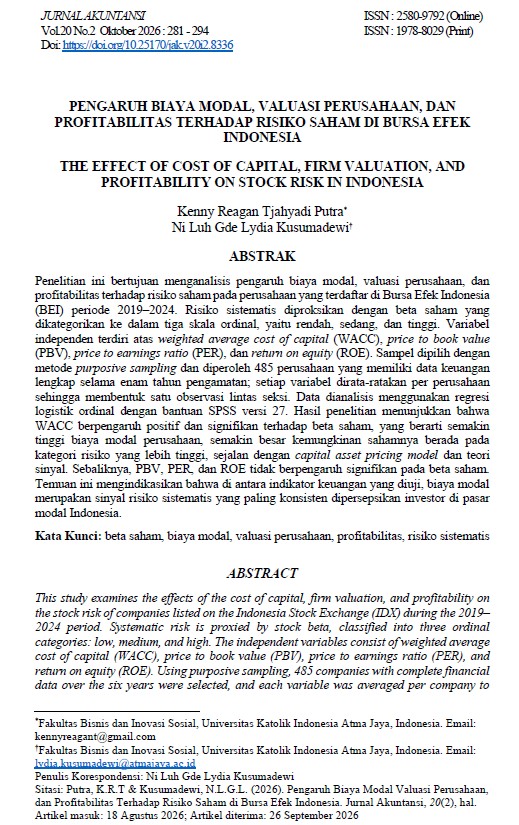
This study examines the effects of the cost of capital, firm valuation, and profitability on the stock risk of companies listed on the Indonesia Stock Exchange (IDX) during the 2019–2024 period. Systematic risk is proxied by stock beta, classified into three ordinal categories: low, medium, and high. The independent variables consist of weighted average cost of capital (WACC), price to book value (PBV), price to earnings ratio (PER), and return on equity (ROE). Using purposive sampling, 485 companies with complete financial data over the six years were selected, and each variable was averaged per company to form a single cross-sectional observation. Data were analysed using ordinal logistic regression in SPSS version 27. The results show that WACC has a positive and significant effect on stock beta, indicating that a higher cost of capital is associated with a higher likelihood of a company being classified into a riskier beta category, consistent with the capital asset pricing model and signalling theory. In contrast, PBV, PER, and ROE do not significantly affect stock beta. These findings suggest that, among the financial indicators examined, the cost of capital is the most consistent signal of systematic risk perceived by investors in the Indonesian capital market.
References
Afrino, J., & Erni, M. (2019). Effect of profitability ratio, solvency, market ratio, and risk ratio on stock return. Proceedings of the Third Padang International Conference on Economics Education, Economics, Business and Management, Accounting and Entrepreneurship (PICEEBA 2019). https://doi.org/10.2991/piceeba-19.2019.66
Chen, J. M. (2021). The capital asset pricing model. Encyclopedia, 1(3), 915-933. https://doi.org/10.2139/ssrn.3844183
Connelly, B. L., Certo, S. T., Ireland, R. D., & Reutzel, C. R. (2011). Signalling theory: a Review and assessment. Journal of Management, 37(1), 39–67. https://doi.org/10.1177/0149206310388419
Fernández, P. (2010). WACC: Definition, misconceptions, and errors. Business Valuation Review, 29(4), 138–144. https://doi.org/10.5791/0897-1781-29.4.138
Gabrielli, L., & French, N. (2021). Pricing to market: Property valuation methods – a Practical review. Journal of Property Investment & Finance, 39(5), 464–480. https://doi.org/10.1108/JPIF-09-2020-0101
Ghozali, I. (2018). Aplikasi Analisis Multivariate dengan Program IBM SPSS 25. Badan Penerbit Universitas Diponegoro.
Hawaldar, I. T. (2011). Relevance of capital asset pricing model – a review. https://www.researchgate.net/publication/313790403
Hutabarat, F. (2022). Price earnings ratio, average volume and stock beta of Indonesia SE Healthcare Companies. Jurnal Terapan Ilmu Manajemen dan Bisnis, 5(2), 142–152. https://doi.org/10.58303/jtimb.v5i2.3030
Kassi, D. F., Rathnayake, D. N., Louembe, P. A., & Ding, N. (2019). Market risk and financial performance of non-financial companies listed on the Moroccan stock exchange. Risks, 7(1), 1-29. https://doi.org/10.3390/risks7010020
Levi, Y., & Welch, I. (2021). Symmetric and asymmetric market betas and downside risk. Review of Financial Studies, 33(6), 2772–2795. https://doi.org/10.1093/RFS/HHZ108
Liau, Y.-S. (2016). Beta asymmetry in the global stock markets following the subprime mortgage crisis. Emerging Markets Finance and Trade, 52(9), 2195–2207. https://doi.org/10.1080/1540496X.2015.1068613
Mehrani, K., Rahnamay Roodposhti, F., Nekomaram, H., & Saeedi, A. (2016). Behavioral trading strategies and investor sentiment: Empirical research in Tehran Stock Exchange (TSE). Indonesian Capital Market Review, 8(2), 94-109. https://doi.org/10.21002/icmr.v8i2.5708
Putra, T. P., Chabachib, M., & Pangestuti, I. R. D. (2007). Pengaruh kinerja keuangan dan beta saham terhadap price to book value (Studi pada perusahaan real estate dan property yang listed di Bursa Efek Indonesia Periode Tahun 2004–2006). Jurnal Studi Manajemen dan Organisasi, 4(2), 81-90. http://ejournal.undip.ac.id/index.php/smo
Rosenberg, B. (1985). Prediction of common stock betas. The Journal of Portfolio Management, 11(2), 5–14. https://doi.org/10.3905/jpm.1985.408997
Rasnawati, A., & Muryati, M. (2023). Pengaruh faktor-faktor fundamental (current ratio, return on asset, return on equity, total asset turn over, debt to equity ratio, dan asset growth) terhadap beta saham telekomunikasi di Bursa Efek Indonesia tahun 2019-2021. Jurnal Ilmiah Universitas Batanghari Jambi, 23(1), 295-298. https://doi.org/10.33087/jiubj.v23i1.3513
Sudana, I. M., & Maulidiyah, H. P. (2018). Price earnings ratio dan pendapatan saham perusahaan non keuangan di BEI. Jurnal Manajemen Teori dan Terapan, 11(2), 161-180. https://doi.org/10.20473/jmtt.v11i2.10493
Sulistiyo, H. (2017). Analisis struktur modal terhadap wacc dan analisis wacc terhadap nilai perusahaan (Studi kasus pada perusahaan rokok yang terdaftar di BEI Periode 2009-2013). Accounthink: Journal of Accounting and Finance, 2(1), 260-272 . https://doi.org/10.35706/acc.v2i01.730
Sultana, M., Imran, M., & Saleem, M. A. (2019). Impact of WACC in elucidation of cross-sectional stock returns by stylized portfolios: Pragmatic Evidence from Pakistan Stock Exchange. Global Management Sciences Review, IV(I), 30–38. https://doi.org/10.31703/gmsr.2019(IV-I).04
Warren, C. S., Reeve, J. M., & Duchac, J. E. (2018). Accounting. Cengage Learning.
Wulansari, I. N. (2014). Analisis faktor-faktor fundamental terhadap beta saham LQ-45 di BEI. Jurnal Ilmu & Riset Manajemen, 3(6), 1-15.
Yusuf, A. (2019). Pengaruh faktor-faktor fundamental (current ratio, return on asset, return on equity, total asset turn over, debt to equity ratio, dan asset growth) terhadap beta saham syariah di Bursa Efek Indonesia. https://doi.org/10.31227/osf.io/8u6pn
Downloads
Published
Issue
Section
License
Copyright (c) 2026 Kenny Reagan Tjahyadi Putra, Lydia Kusumadewi

This work is licensed under a Creative Commons Attribution-ShareAlike 4.0 International License.
Authors who publish with this journal agree to the following terms:
- Authors retain copyright and grant the journal right of first publication with the work simultaneously licensed under a Creative Commons Attribution-ShareAlike 4.0 International License that allows others to share the work with an acknowledgment of the work's authorship and initial publication in this journal.
- Authors are able to enter into separate, additional contractual arrangements for the non-exclusive distribution of the journal's published version of the work (e.g., post it to an institutional repository or publish it in a book), with an acknowledgment of its initial publication in this journal.
- Authors are permitted and encouraged to post their work online (e.g., in institutional repositories or on their website) prior to and during the submission process, as it can lead to productive exchanges, as well as earlier and greater citation of published work.