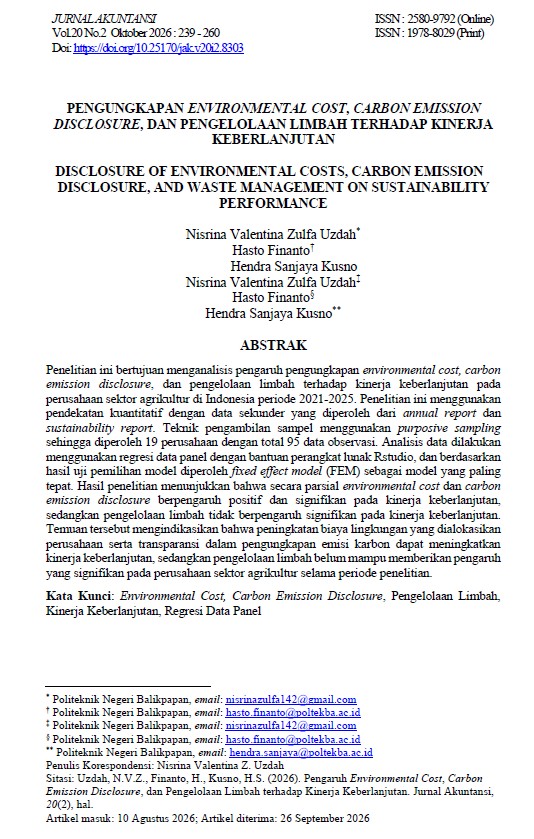
PENGUNGKAPAN ENVIRONMENTAL COST, CARBON EMISSION DISCLOSURE, DAN PENGELOLAAN LIMBAH TERHADAP KINERJA KEBERLANJUTAN
DOI:
https://doi.org/10.25170/jak.v20i2.8303Keywords:
Environmental Cost, Carbon Emission Disclosure, Waste ManagementAbstract
This study aims to examine the effect of environmental cost, carbon emission disclosure, and waste management on sustainability performance in agricultural sector companies in Indonesia during the 2021–2025 period. This study employs a quantitative approach using secondary data from annual reports and sustainability reports. The sampling technique was purposive sampling, yielding 19 companies and 95 observations. Data were analyzed using panel data regression with RStudio. Based on model selection tests, the fixed effect model (FEM) was identified as the most appropriate model. The results indicate that environmental cost and carbon emission disclosure have a positive and significant effect on sustainability performance, while waste management has no significant effect. These findings indicate that greater environmental cost allocation and increased transparency in carbon emissions disclosure contribute to improved sustainability performance. Waste management practices have not demonstrated a significant influence on sustainability performance among agricultural sector companies during the study period.
References
Alakkas, A. A., Shabir, S., Alhumoudi, H., Boukhris, M., Baig, A., & Khan, I. A. (2023). The impact of sustainability accounting on environmental performance and productivity: a Panel data analysis. International Journal of Sustainable Development and Planning, 18(8), 2431–2441. https://doi.org/10.18280/ijsdp.180814
Andira, R., & Meidiyustiani, R. (2026). Pengaruh pengungkapan emisi karbon, agresivitas pajak, capital intensity, dan leverage terhadap nilai perusahaan. RIGGS: Journal of Artificial Intelligence and Digital Business, 5(1), 7026–7035. https://doi.org/10.31004/riggs.v5i1.7104
Asha’ari, M. J., Daud, S., Jamil, A. H., Deli, M. M., Rauf, U. A. A., & Abdullah, S. I. N. W. (2023). Waste management and business sustainability performance: Moderating role of organisation age. Journal of Management Scholarship, 2(2). https://doi.org/10.38198/jms/2.2.2023.22
Asyadiah, N., Huda, S., & Nurhanifah, A. (2025). Green accounting, carbon emission disclosure, sustainable development: the Moderating role of environmental management system. Gorontalo Accounting Journal, 8(2), 424–434. https://doi.org/10.32662/gaj.v8i2.3909
Choi, B. B., Lee, D., & Psaros, J. (2013). An analysis of Australian company carbon emission disclosures. Pacific Accounting Review, 25(1), 58–79. https://doi.org/https://doi.org/10.1108/01140581311318968
Elkington, J. (1997). Cannibals with forks: the Triple bottom line of 21st century business (pp. 1–418). Capstone Publishing Limited.
Gabrielle, & Toly, A. A. (2019). The effect of greenhouse gas emissions disclosure and environmental performance on firm value: Indonesia evidence. Jurnal Ilmiah Akuntansi dan Bisnis. https://doi.org/10.24843/jiab.2019.v14.i01.p10
GRI 305: Emissions. (2016).
GRI 306: Waste. (2020).
Haifa, A. H., Oktaviana, A. Y., & Kamal, U. (2024). Tantangan dan solusi pengelolaan limbah industri: Upaya menuju lingkungan. Jurnal Ilmiah Wahana Pendidikan, Desember, 10(23), 1133–1139. https://jurnal.peneliti.net/index.php/JIWP/article/view/9313
Jauza, N. A., & Albina, M. (2025). Model dan pendekatan penelitian kuantitatif: Kajian filosofis, metodologis, dan aplikatif. QOUBA : Jurnal Pendidikan, 2(1), 104–111. https://doi.org/10.61104/qb.v2i1.280
Kementerian Lingkungan Hidup. (2025, June 22). Memahami AMDAL: Mengapa setiap proyek besar memerlukan kajian lingkungan. Elearning.Kemenlh.Go.Id. https://elearning.kemenlh.go.id/pusat-pengetahuan/memahami-amdal-mengapa-setiap-proyek-besar-memerlukan-kajian-lingkungan
Kim, T. H., & Kim, B. (2018). Firm’s environmental expenditure, R & D intensity, and profitability. Sustainability (Switzerland), 10(6). https://doi.org/10.3390/su10062071
Kusumaningrum, S. I. (2019). Pemanfaatan sektor pertanian sebagai penunjang pertumbuhan perekonomian Indonesia. Jurnal Transaksi, 11(1), 80-89.
Laksmi, P. A. S., Saputra, K. A. K., Noordin, N. MD., & Bareto, C. A. (2024). The effect of competitive advantage and sustainable management on sustainability performance. Jurnal Bisnis dan Akuntansi. https://doi.org/http://jurnaltsm.id/index.php/JBA
Lumi, C. A., Johnly, R., Wehelmina, P., Jurusan, R., Administrasi, I., & Bisnis, A. (2023). Implementasi corporate social responsibility berdasarkan konsep triple bottom line pada PT Bank SulutGo. Productivity, 4(4).
Margareta, H., & Arisman, A. (2026). Pengaruh biaya lingkungan terhadap kinerja keuangan perusahaan (Studi empiris pada perusahaan basic material yang terdaftar di Bursa Efek Indonesia tahun 2022-2024 ). RIGGS: Journal of Artificial Intelligence and Digital Business, 5(1), 5720–5727. https://doi.org/10.31004/riggs.v5i1.6757
Mishra, P., & Pandey, V. K. (2025). Triple bottom line and environmental sustainability: Evolution of global ESG research—a bibliometric analysis. Environmental Sciences Europe, 37(1), 37–136. https://doi.org/10.1186/s12302-025-01184-9
Naiborhu, N. S. (2018). Pelaksanaan tanggung jawab sosial dan lingkungan pada PT. Freeport Indonesia sebagai PT. penanam modal dalam rangka perlindungan dan pengelolaan lingkungan hidup. Jurnal Hukum Mimbar Justitia, 4(1), 63-88. https://doi.org/10.35194/jhmj.v4i1.351
Novianti, F., Purnamawati, G. A., & Kurniawan, P. S. (2020). Determinasi pengungkapan emisi karbon pada perusahaan prtambangan dan pertanian di Indonesia. JIMAT (Jurnal Ilmiah Mahasiswa Akuntansi), 11. https://doi.org/https://doi.org/10.23887/jimat.v11i1.24657
Nursabrina, A., Joko, T., & Septiani, O. (2021). Kondisi pengelolaan limbah b3 industri di Indonesia dan potensi dampaknya: Studi literatur. Jurnal Riset Kesehatan Poltekkes Depkes Bandung, 13(1), 80–90. https://doi.org/10.34011/juriskesbdg.v13i1.1841
Oduro, S. (2024). Eco-innovation and SMEs’ sustainable performance: a Meta-analysis. European Journal of Innovation Management, 27(9), 248–279. https://doi.org/10.1108/EJIM-11-2023-0961
Oranga, J., & Matere, A. (2025). Quantitative research: Types, advantages, generalizability & limitations. OALib, 12(09), 1–9. https://doi.org/10.4236/oalib.1113694
Pour-Aboughadareh, A., Omidi, M., Naghavi, M. R., Etminan, A., Mehrabi, A. A., & Poczai, P. (2020). Wild relatives of wheat respond well to water deficit stress: a Comparative study of antioxidant enzyme activities and their encoding gene expression. Agriculture (Switzerland), 10(9), 1–13. https://doi.org/10.3390/agriculture10090415
Pratama, A. S., & Sisdianto, E. (2024). Tanggung jawab lingkungan dalam bisnis: strategi beretika untuk masa depan hijau. Jurnal Ilmiah Ekonomi Manajemen Bisnis dan Akuntansi, 1(4). https://doi.org/10.61722/jemba.v1i4.524
Putra, N. N. (2017, July 22). POJK sustainable finance terbit, setiap korporasi wajib laporkan rencana aksi. https://www.hukumonline.com/berita/a/pojk-isustainable-finance-i-terbit--setiap-korporasi-wajib-laporkan-rencana-aksi-lt5972d636a3b8c/
Rakos, I. S., & Antohe, A. (2014). Environmental cost - an Environment management accounting component. International Journal of Academic Research in Accounting, Finance and Management Sciences, 4(4), 166-175. https://doi.org/10.6007/ijarafms/v4-i4/1302
Ratnaningrum, R., Hermawan, D., Susilo, B. W., & Khaq, Z. D. (2025). The effect of environmental costs and profitability on environmental performance. Journal of Management and Informatics, 4(2), 844–858. https://doi.org/10.51903/jmi.v4i2.214
Rezky, M., Asshari, N. I., Permatasari, A., & Majid, J. (2026). Pengaruh penerapan akuntansi lingkungan, pengelolaan limbah, dan corporate social responsibility (csr) terhadap kinerja bisnis berkelanjutan. Sigaruda Journal: Jurnal Ilmiah Bidang Sosial, Ekonomi, Budaya, Teknologi dan Pendidikan, 1(3).
Rizky, G. M., Stefana, V. E., & Nauly, E. (2025, January 8). Tanggung jawab sosial dan lingkungan perusahaan: Implementasi dan strategi efektif. https://www.hukumonline.com/berita/a/tanggung-jawab-sosial-dan-lingkungan-perusahaan--implementasi-dan-strategi-efektif-lt677d66f783639/
Rusmana, O., & Purnaman, S. M. N. (2020). Pengaruh pengungkapan emisi karbon dan kinerja lingkungan terhadap nilai perusahaan. Jurnal Ekonomi, Bisnis dan Akuntansi (JEBA), 22. https://doi.org/https://doi.org/10.32424/jeba.v22i1.1563
Siddique, M. A., Karim, S., Haque, M. R., & Mia, P. (2026). The truth behind sustainability claims: Examining carbon risk, ESG disclosures, and greenwashing. International Review of Financial Analysis, 109, 104735. https://doi.org/10.1016/j.irfa.2025.104735
Siwawa, V. (2025). Assessing waste management performance in smart cities through the ‘Zero Waste Index’: Case of African Waste Reclaimers Organisation, Johannesburg, South Africa. Frontiers in Sustainable Cities, 7. https://doi.org/10.3389/frsc.2025.1449868
Suartana, I. W. (2010). Akuntansi lingkungan dan triple bottom line accounting: Paradigma baru akuntansi bernilai tambah. Jurnal Bumi Lestari, 10(1), 105-112.
Widjaja, G. (2025). Corporate legal responsibility in the context of environmental sustainability and corporate governance. Journal of Environmental Law and Policy, 5(2), 3476. https://doi.org/10.54517/jelp3476
Wijaya, I., Rahardjo, K., Abdillah, Y., & Riza, M. F. (2025). Sustainability performance in business: a Systematic review of leadership, culture, capability and digital marketing contributions. Cogent Business and Management, 12(1), 1-17. https://doi.org/10.1080/23311975.2025.2543049
Xie, C., Wang, X., & Fukuda, D. (2020). On the pricing of urban rail transit with track sharing freight service. Sustainability, 12(7), 1-29. https://doi.org/10.3390/su12072758
Zimek, M., & Baumgartner, R. (2017, October). Corporate sustainability activities and sustainability performance of first and second order. In 18th European Roundtable on Sustainable Consumption and Production Conference (ERSCP 2017), Skiathos Island, Greece (Vol. 10).
Downloads
Published
Issue
Section
License
Copyright (c) 2026 Nisrina Valentina Zulfa Uzdah

This work is licensed under a Creative Commons Attribution-ShareAlike 4.0 International License.
Authors who publish with this journal agree to the following terms:
- Authors retain copyright and grant the journal right of first publication with the work simultaneously licensed under a Creative Commons Attribution-ShareAlike 4.0 International License that allows others to share the work with an acknowledgment of the work's authorship and initial publication in this journal.
- Authors are able to enter into separate, additional contractual arrangements for the non-exclusive distribution of the journal's published version of the work (e.g., post it to an institutional repository or publish it in a book), with an acknowledgment of its initial publication in this journal.
- Authors are permitted and encouraged to post their work online (e.g., in institutional repositories or on their website) prior to and during the submission process, as it can lead to productive exchanges, as well as earlier and greater citation of published work.