
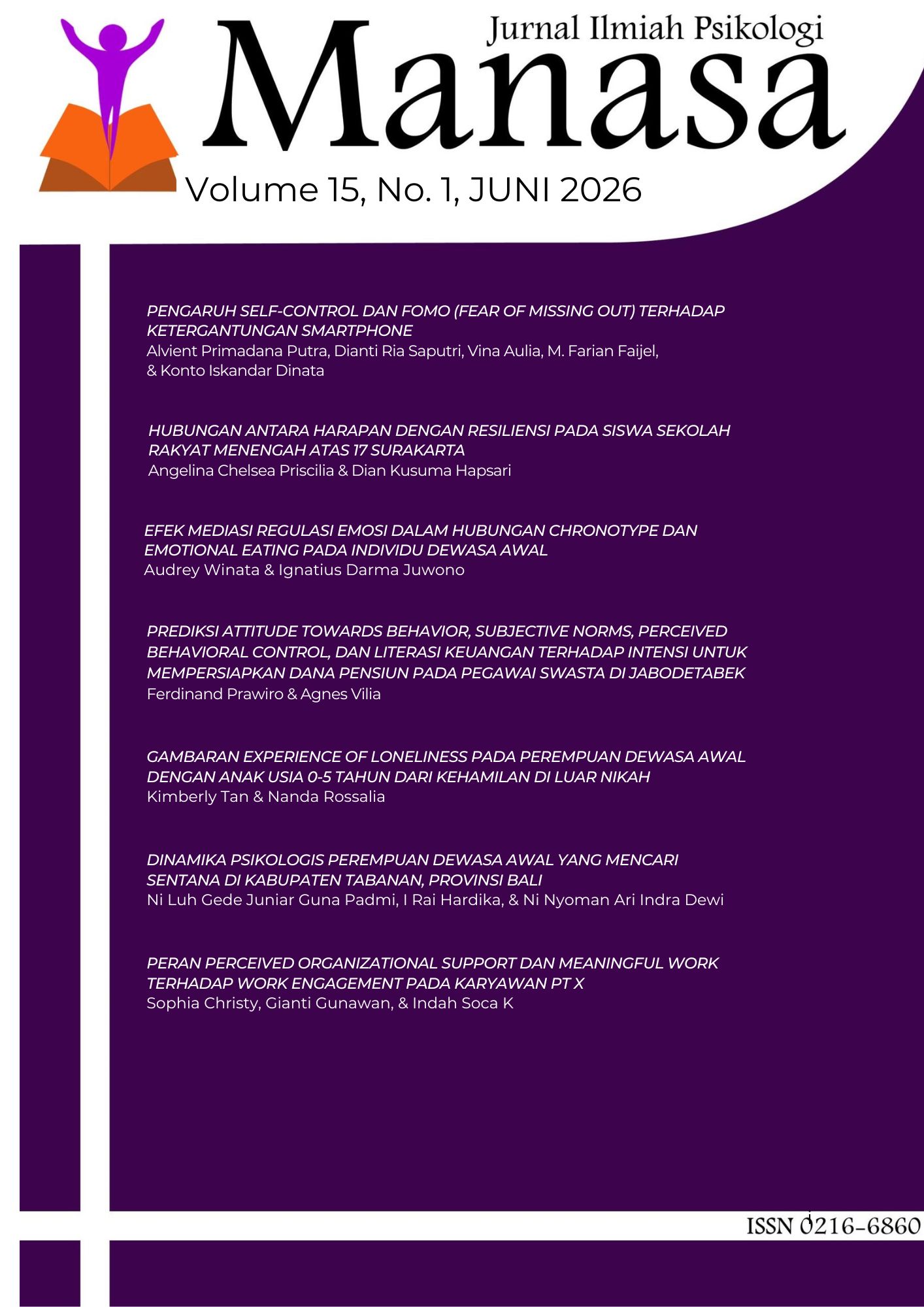
HUBUNGAN ANTARA HARAPAN DENGAN RESILIENSI PADA SISWA SEKOLAH RAKYAT MENENGAH ATAS 17 SURAKARTA
DOI:
https://doi.org/10.25170/manasa.v15i1.7711Keywords:
harapan, kemiskinan, remaja, resiliensiAbstract
Remaja yang hidup dalam kemiskinan menghadapi berbagai tantangan yang signifikan bagi perkembangan dirinya. Kesulitan ekonomi meningkatkan kerentanan remaja yang sedang mengalami perubahan biologis, psikologis, dan sosial yang kompleks. Dalam kondisi tersebut, resiliensi—yaitu kemampuan untuk menghadapi tekanan dan bangkit dari kesulitan—menjadi faktor penting. Salah satu faktor protektif yang diduga dapat memperkuat resiliensi adalah harapan (hope). Penelitian ini bertujuan untuk menguji hubungan antara harapan dan resiliensi pada siswa Sekolah Rakyat Menengah Atas 17 Surakarta. Resiliensi diukur menggunakan Resilience Quotient, sedangkan harapan diukur menggunakan Adult Hope Scale. Partisipan penelitian berjumlah 185 siswa yang berasal dari keluarga miskin dan sangat miskin. Data dianalisis menggunakan regresi linier sederhana dengan bantuan SPSS Statistics versi 25.0. Hasil penelitian menunjukkan adanya hubungan positif dan signifikan antara harapan dan resiliensi pada siswa. Harapan juga memberikan kontribusi signifikan terhadap resiliensi remaja. Temuan ini mengindikasikan bahwa harapan berhubungan secara positif dan signifikan dengan resiliensi pada remaja dari keluarga miskin. Penelitian ini diharapkan dapat menjadi referensi bagi penelitian selanjutnya serta menjadi dasar pengembangan program yang bertujuan meningkatkan harapan dan resiliensi pada remaja yang hidup dalam keterbatasan ekonomi.
References
Adewoye, S. E. (2024). Factors that Influence Academic Resilience of Students from Economically Disadvantaged Environments in South Africa During the COVID-19 Era. Journal of Education and Learning Technology, 5(10), 400-412. https://doi.org/10.38159/jelt.20245102
Adiba, A. (2024). Navigating challenges: The Role of Resilience in Childhood and Adolescence. International Journal of Emergency Mental Health and Human Resilience, 26(5), 144-145. https://doi.org/10.4172/1522-4821.1000662
Assari, S., Najand, B., Najand, I., & Grace, S. (2024). Behavioral and psychosocial correlates of hope among youth. Journal of Medicine, Surgery, and Public Health, 2, 100088.
Atak, N. T., & Bebiş, H. (2024). Risk Factors Affecting the Psychological Resilience of Adolescents in Institutional Care: A Systematic review. Psychiatry and Clinical Psychopharmacology, 34(3), 252-264. https://doi.org/10.5152/pcp.2024.23782
Ayriza, Y., & Izzaty, R. E. (2023). No differences of adolescent’s hope in terms of developmental phases and gender. Humaniora, 14(2), 105-111. https://doi.org/10.21512/humaniora.v14i2.8510
Brody, G. H., Yu, T., & Beach, S. R. (2016). Resilience to adversity and the early origins of disease. Development and Psychopathology, 28(4pt2), 1347-1365. https://doi.org/10.1017/S0954579416000894
Brody, G. H., Yu, T., Miller, G. E., & Chen, E. (2016). Resilience in adolescence, health, and psychosocial outcomes. Pediatrics, 138(6). https://doi.org/10.1542/peds.2016-1042
Bulut, N. S., Çarkaxhiu Bulut, G., Yorguner Küpeli, N., Genç, H. A., Aktaş, İ., Yaşar, V., Aktaş, M. C., & Topçuoğlu, V. (2019). Living in difficult conditions: an analysis of the factors associated with resilience in youth of a disadvantaged city. Psychiatry and Clinical Psychopharmacology, 29(4), 587-596. https://doi.org/10.1080/24750573.2018.1505281
Chui, W. H., & Wong, M. Y. (2017). Association between parents’ marital status and the development of purpose, hope, and self-esteem in adolescents in Hong Kong. Journal of Family Issues, 38(6), 820-838. https://doi.org/10.1177/0192513X15606490
Dashiff, C., DiMicco, W., Myers, B., & Sheppard, K. (2009). Poverty and Adolescent Mental Health. Journal of Child and Adolescent Psychiatric Nursing, 22(1), 23-32. https://doi.org/10.1111/j.1744-6171.2008.00166.x
Dixson, D. D., Keltner, D., Worrell, F. C., & Mello, Z. (2018). The magic of hope: hope mediates the relationship between socioeconomic status and academic achievement. The Journal of Educational Research, 111(4), 507-515. http://dx.doi.org/10.1080/00220671.2017.1302915
Fawzia, M. (2017). Gambaran resiliensi pada siswa miskin (Survey di SMP Negeri se-Kecamatan Rawamerta) [Skripsi Sarjana, Universitas Negeri Jakarta]. Universitas Negeri Jakarta. http://repository.unj.ac.id/26339/
Fraser, A. M., Bryce, C. I., Alexander, B. L., & Fabes, R. A. (2021). Hope levels across adolescence and the transition to high school: Associations with school stress and achievement. Journal of Adolescence, 91, 48-58. https://doi.org/10.1016/j.adolescence.2021.07.004
Ginting, E. (2024). Hubungan antara hope (harapan) dan resiliensi pada remaja korban erupsi gunung Sinabung [Skripsi Sarjana, Universitas Kristen Satya Wacana]. Universitas Kristen Satya Wacana. https://repository.uksw.edu//handle/123456789/35262
Guo, X. (2019). Coping as a mediator between parental attachment and resilience: An examination of differential effects between Chinese adolescents from single-parent families versus those from intact families. Psychological Reports, 122(2), 506-524. https://doi.org/10.1177/0033294118765418
Karna, W., Ahmmed, B., & Hakobyan A. (2025). Exploring hope and future orientation in adolescents from low income communities. Journal of Adolescent and Youth Psychological Studies, 6(2), 127-135. http://dx.doi.org/10.61838/kman.jayps.6.2.14
Kumari, M., & Sinha, A. R. (2025). Does age and gender influence resilience in adolescents? Journal of Neonatal Surgery, 14(9s), 653-657.
Leung, J. T., & Shek, D. T. (2011). Poverty and adolescent developmental outcomes: A critical review. International Journal of Adolescent Medicine and Health, 23(2), 109-114. https://doi.org/10.1515/IJAMH.2011.019
Li, Z., & Li, Q. (2024). How social support affects resilience in disadvantaged students: The chain-mediating roles of school belonging and emotional experience. Behavioral Sciences, 14(2), 114. https://doi.org/10.3390/bs14020114
Liu, Y., & Ngai, S. Y. (2019). The impact of social capital, self-efficacy, and resilience on the prosocial involvement of adolescents from families with and without economic disadvantages. Child Indicators Research, 12(5), 1735-1757. https://doi.org/10.1007/s12187-018-9607-7
Muharromah, R., & Hendriani, W. (2020). Hubungan antara harapan (hope) dengan resiliensi terhadap istri yang mengalami involuntary childless. Jurnal Psikologi dan Kesehatan Mental, 4(1), 19-27. https://doi.org/10.20473/jpkm.v4i12019.19-27
Ng, E. C., Lam, J. K., & Chan, C. C. (2017). The positive adjustment of low-income youths with relational and community support: The mediating role of hope. Merrill-Palmer Quarterly, 63(4), 514-542. https://doi.org/10.13110/merrpalmquar 1982.63.4.0514
Pfeiffer, J. P., Pinquart, M., & Krick, K. (2016). Social relationships, prosocial behaviour, and perceived social support in students from boarding schools. Canadian Journal of School Psychology, 31(4), 279-289. https://doi.org/10.1177/0829573516630303
Pyari, D., & Muddgal, A. (2019). Comparative study: Optimism and resilience among adolescent. International Journal of Research and Analytical Reviews, 6(1), 503-511.
Rasmanah, M. (2020). Resiliensi dan kemiskinan: Studi kasus. Intizar, 26(1), 33-44. https://doi.org/10.19109/intizar.v26i1.5106
Reivich, K., & Shatté, A. (2002). The resilience factor: 7 essential skills for overcoming life's inevitable obstacles. New York: Broadway Books.
Roesch, S. C., Duangado, K. M., Vaughn, A. A., Aldridge, A. A., & Villodas, F. (2010). Dispositional hope and the propensity to cope: A daily diary assessment of minority adolescents. Cultural Diversity & Ethnic Minority Psychology, 16(2), 191-198. https://doi.org/10.1037/a0016114
Rutter, M. (1985). Resilience in the face of adversity: protective factors and resistance to psychiatric disorder. The British Journal of Psychiatry, 147(6), 598-611. https://doi.org/10.1192/bjp.147.6.598
Ruwaedah, S., & Dewi, E. M. P. (2023). Konsep diri remaja ditinjau dari status pernikahan orang tua. Journal of Correctional Issues Volume, 6(2), 452-459.
Scarvanovi, B. W., Syifa, L. A. S., & Hidayati, F. (2020). Hope and resilience among pre-championship athletes with disabilities. Journal of ICSAR ISSN, 4(1), 22-26.
Schultz, K. V. (2016). Examining hope and resilience among mississippi adolescents [Dissertation, University of Mississippi]. University of Mississippi. https://egrove.olemiss.edu/etd/1518
Siddiqi, Z., Pathania, B., & Shirodker, A. G. (2025). Exploring hope and resilience as determinants of emotional intelligence among adolescents. International Journal of Innovative Science and Research Technology, 10(7), 1458-1465. https://doi.org/10.38124/ijisrt/25jul757
Singh, R., Mahato, S., Singh, B., Thapa, J., & Gartland, D. (2019). Resilience in Nepalese adolescents: Socio-demographic factors associated with low resilience. Journal of multidisciplinary healthcare, 893-902. https://doi.org/10.2147/JMDH.S226011
Snyder, C. R. (2002). Hope theory: Rainbows in the mind. Psychological Inquiry, 13(4), 249-275. https://doi.org/10.1207/S15327965PLI1304_01
Sugiyono. (2016). Metode penelitian kuantitatif, kualitatif, dan R&D. Bandung: Alfabeta.
Sünbül, Z. A., & Çekici, F. (2018). Hope as unique agent of resilience in socio-economically disadvantaged adolescents. International Journal of Evaluation and Research in Education, 7(4), 299-304. https://doi.org/10.11591/ijere.v7i4.15354
Venning, A. J., Eliott, J., Kettler, L., & Wilson, A. (2009). Normative data for the Hope Scale using Australian adolescents. Australian Journal of Psychology, 61(2), 100–106. https://doi.org/10.1080/00049530802054360
Vinayak, S., & Judge, J. (2018). Resilience and empathy as predictors of psychological well-being among adolescents. International Journal of Health Sciences and Research, 8(4), 192-200.
Warnick, J. E., & Munongi, L. (2025). Resilience factors associated with mental health of adolescent learners living with mild and moderate intellectual difficulties. Discover Mental Health, 5(1), 1-16. https://doi.org/10.1007/s44192-025-00259-6
Zambelli, M., Ellena, A. M., Tagliabue, S., Pozzi, M., & Marta, E. (2024). The role of resilience in fostering late adolescents’ meaning-making process: A latent profile analysis. Journal of Happiness Studies, 25(7), 91. https://doi.org/10.1007/s10902-024-00803-1
Zhang, X., Ray, S. A., Liu, X., Smith, D. M., & Hou, W. (2023). What makes left-behind children resilient? And how? The role of hope on the resilience of Chinese left-behind children. Children and Youth Services Review, 153, 107092. https://doi.org/10.1016/j.childyouth.2023.107092
Zita, F. (2020). Pengaruh hope dan mindfulness terhadap kesejahteraan spiritual penderita diabetes melitus [Skripsi Sarjana, Universitas Islam Negeri Syarif Hidayatullah Jakarta]. Universitas Islam Negeri Syarif Hidayatullah Jakarta. https://repository.uinjkt.ac.id/dspace/handle/12345
Downloads
Published
Issue
Section
License
Copyright (c) 2026 MANASA

This work is licensed under a Creative Commons Attribution-NonCommercial-ShareAlike 4.0 International License.








.png)
.png)