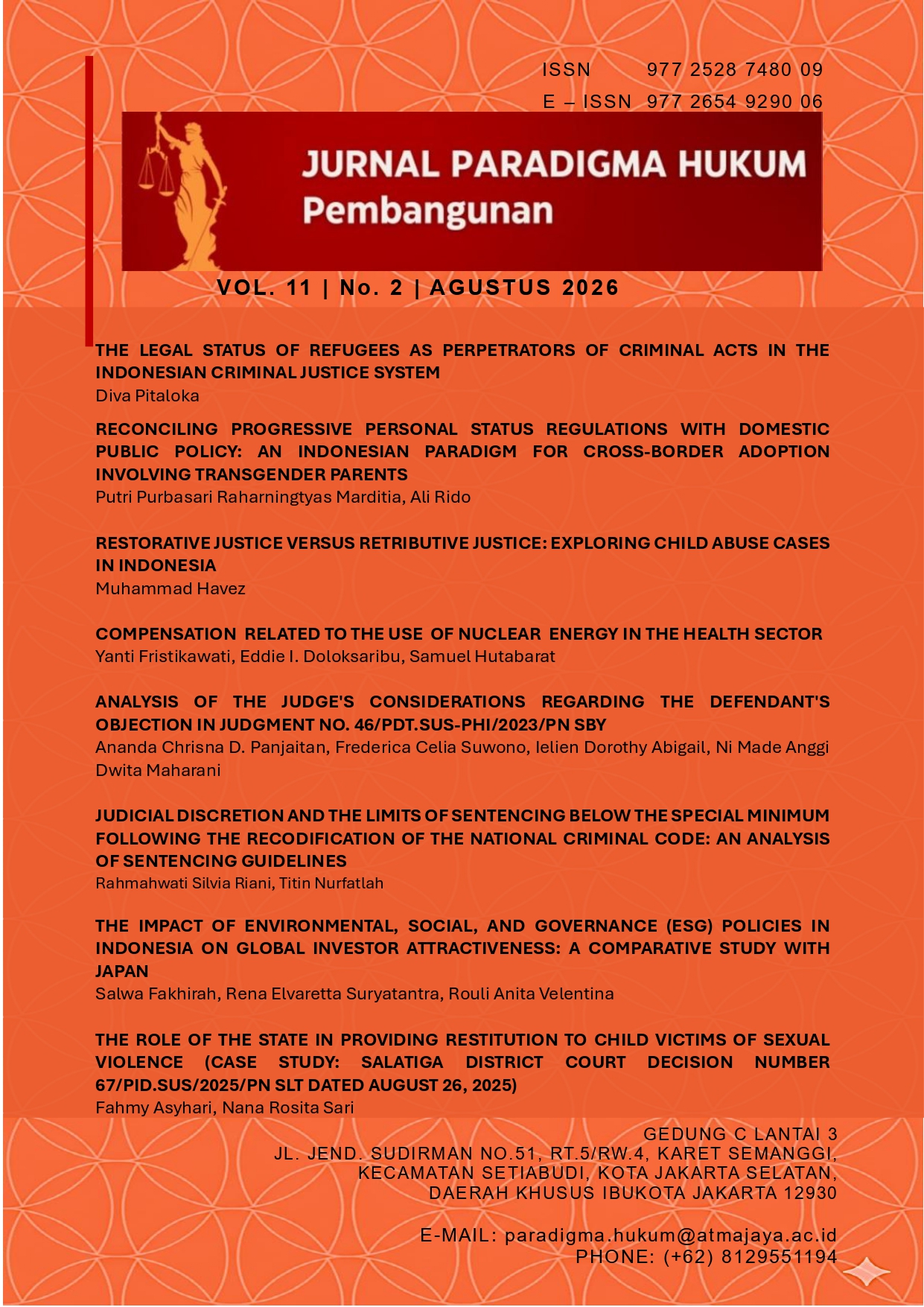
Restorative Justice versus Retributive Justice: Exploring Child Abuse Cases in Indonesia
DOI:
https://doi.org/10.25170/paradigma.v11i2.8258Kata Kunci:
Restorative justice, retributive justice, child abuse, rehabilitation of victim, indonesiaAbstrak
Law enforcement of child abuse cases in Indonesia presents complex challenges, particularly in determining the most effective justice approach for both victims and perpetrators. This article compares Restorative Justice and Retributive Justice in handling child abuse cases, focusing on their impact on victim rehabilitation, deterrent effects on perpetrators, and protection for victims. Restorative Justice, which focuses on restoring relationships between victims and perpetrators, can accelerate the rehabilitation process and reduce long-term trauma for victims. Conversely, Retributive Justice, which prioritizes punishment for perpetrators and aims to provide a deterrent effect, often neglects the aspect of recovery for victims. This article also explores the social and psychological impacts experienced by victims depending on the approach used, as well as the challenges faced by the Indonesian legal system in effectively implementing Restorative Justice in child abuse cases. By understanding these two approaches, it is hoped that more comprehensive solutions can be found in handling child abuse cases in Indonesia.
Referensi
Braithwaite, J. “Principles of Restorative Justice.” Restorative Justice and Criminal Justice: Competing or Reconcilable Paradigms 360 (2003): 1–20. https://doi.org/https://www.torrossa.com/en/resources/an/5211657#page=13.
Carlsmith, K. M., & Darley, J. M. “Psychological Aspects of Retributive Justice.” Advances in Experimental Social Psychology 40 (2008): 193–236. https://doi.org/https://doi.org/10.1016/S0065-2601(07)00004-4.
Carlsmith, K. M. “The Roles of Retribution and Utility in Determining Punishment.” Journal of Experimental Social Psychology 42, no. 4 (2006): 437–51. https://doi.org/https://doi.org/10.1016/j.jesp.2005.06.007.
Darmika, I. “Diversion and Restorative Justice in the Criminal Justice System of Children in Indonesia.” Ijtimā Iyya Journal of Muslim Society Research 3, no. 2 (2018): 180–211. https://doi.org/https://doi.org/10.24090/ijtimaiyya.v3i2.1921.
Eliandi, T., Prasetyo, T., & Yudianto, O. “Handling of Children by Diversion in Children Protection (Diversion and Restorative Justice).” Research, Society and Development 10, no. 1 (2021): e26010111826–e26010111826. https://doi.org/https://doi.org/10.33448/rsd-v10i1.11826.
Flora, H. S. “Restorative Justice in the New Criminal Code in Indonesia: A Prophetic Legal Study.” Rechtsidee 11 (2022): 10–21070. https://doi.org/https://doi.org/10.21070/jihr.v11i0.836.
Hasibuan, L. R. “The Concept of Restorative Justice in the Juvenile Criminal Justice System: A Narrative Review of the Indonesian Context.” Sch Int J Law Crime Justice 5, no. 7 (2022): 263–72. https://doi.org/10.36348/sijlcj.2022.v05i07.004.
Morse, Stephen J. “Mental Disorder and Criminal Law.” J. Crim. L. & Criminology 101, no. 3 (2013). https://doi.org/0091.4169/11/.
Permana, Y., Yoserwan, Y., & Elvandari, S. “Application of Restorative Justice Principles in Judges’ Considerations in Decisions to Release from All Legal Charges (Decision Case Study Number: 28/Pid. B/2022/PN. LBB).” UNES Law Review 6, no. 4 (2024): 12251–63. https://doi.org/https://doi.org/10.31933/unesrev.v6i4.2197.
Perry, R. “The Role of Retributive Justice in the Common Law of Torts: A Descriptive Theory.” Tenn. L. Rev 73 (n.d.): 177. https://doi.org/https://heinonline.org/HOL/LandingPage?handle=hein.journals/tenn73&div=14&id=&page=.
Puspita, P. “The Effectiveness of Implementing Restorative Justice in Handling Child Crimes in Indonesia.” Indonesian Journal of Law and Humanities 1, no. 1 (2025): 16–23. https://doi.org/https://journal.jinovasi.com/index.php/ijlh/article/view/21.
Rosyid, M. A., & Hastuti, D. “Implementasi Restorative Justice Melalui Upaya Rehabilitasi Dan Reintegrasi Sosial. Bagi Anak Yang Berkonflik Dengan Hukum.” Reformasi 12, no. 2 (2022): 282–93. https://doi.org/https://10.33366/rfr.v%vi%i.4061.
Wenzel, M., & Okimoto, T. G. “Retributive Justice.” In Handbook of Social Justice Theory and Research, 237–56, 2016. https://doi.org/https://doi.org/10.1007/978-1-4939-3216-0_13https://doi.org/10.1007/978-1-4939-3216-0_13.
Wenzel, M., Okimoto, T. G., Feather, N. T., & Platow, M. J. “Retributive and Restorative Justice.” Law and Human Behavior 32, no. 5 (2008): 375–89. https://doi.org/https://doi.org/10.1007/s10979-007-9116-6.
———. “Retributive and Restorative Justice.” Law and Human Behavior 32 (2008): 375–89. https://doi.org/https://doi.org/10.1007/s10979-007-9116-6.
Unduhan
Diterbitkan
Terbitan
Bagian
Lisensi
Hak Cipta (c) 2026 Jurnal Paradigma Hukum Pembangunan

Artikel ini berlisensiCreative Commons Attribution-NonCommercial-ShareAlike 4.0 International License.
Diperbolehkan atau tidak mempublikasikan tulisan di resopitory instansi penulis