About the Journal
About the Journal
Jurnal Elektro (p-ISSN 1979-9780; e-ISSN 2746-4288) is a double-blind peer-reviewed, open-access scientific journal published by the Department of Electrical Engineering, School of Bioscience, Technology, and Innovation, Universitas Katolik Indonesia Atma Jaya (Atma Jaya Catholic University of Indonesia). First published in print in April 2008 and online since April 2014, the journal provides a platform for the dissemination of high-quality research and advances in the field of electrical engineering. Every article is assigned a DOI (prefix 10.25170) registered with Crossref.
Jurnal Elektro is published twice a year, in April and October, is free of charge for authors and readers, and is licensed under CC BY 4.0.
The editorial office can be contacted at:
Department of Electrical Engineering,
School of Bioscience, Technology, and Innovation,
Universitas Katolik Indonesia Atma Jaya,
Campus 3 BSD City, Jl. Cisauk, Sampora, Cisauk, Tangerang, Banten 15345, Indonesia
Tel.: +62 21 570 8826
Email: jurnal.elektro@atmajaya.ac.id
Accreditation
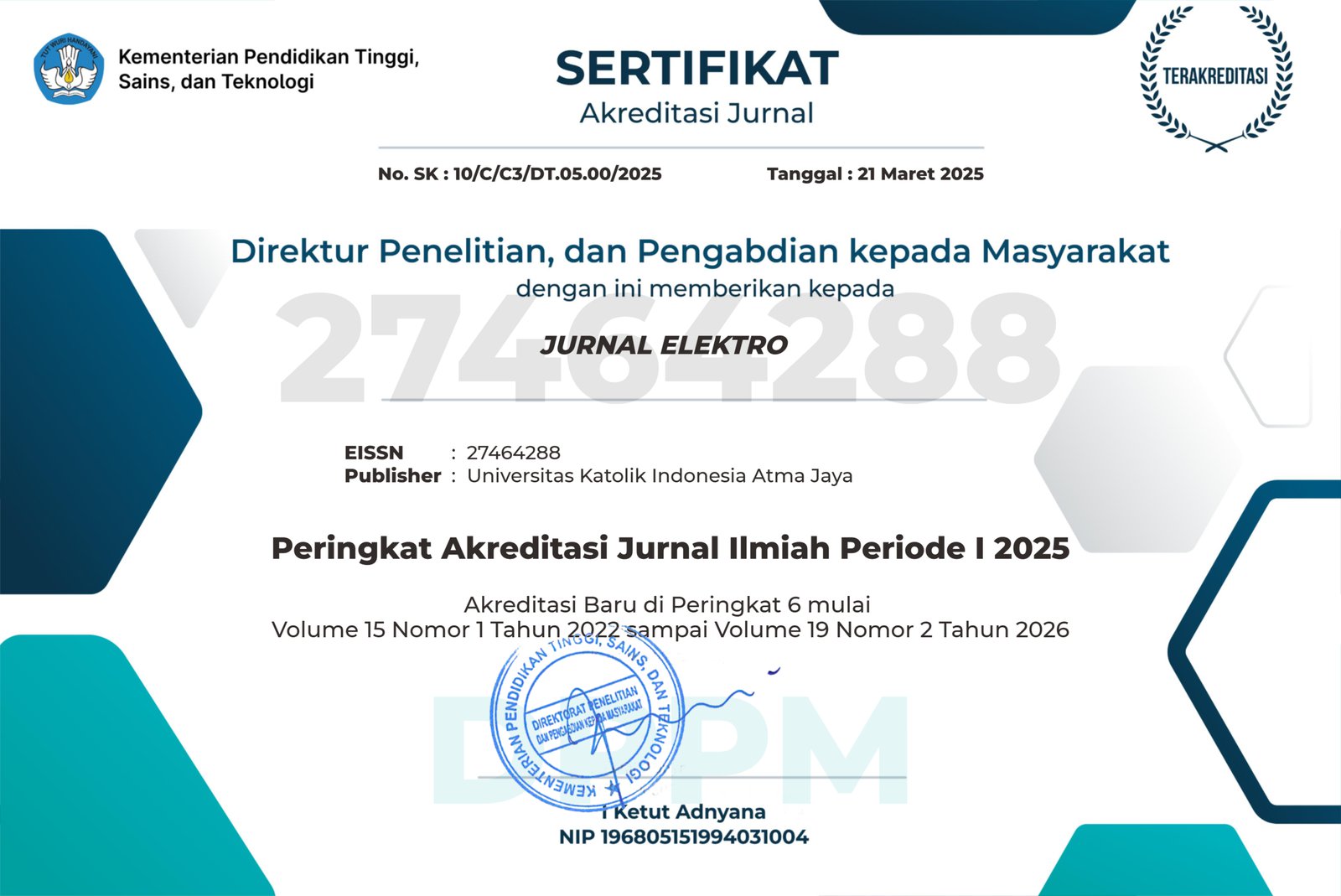
Jurnal Elektro is accredited by the Ministry of Higher Education, Science, and Technology of the Republic of Indonesia at Rank 6 (SINTA 6) under Decree No. 10/C/C3/DT.05.00/2025, dated 21 March 2025 (new accreditation, Accreditation Period I 2025). The accreditation is valid from Volume 15 Number 1 (2022) to Volume 19 Number 2 (2026). Journal profile: SINTA.
Focus and Scope
Jurnal Elektro publishes original research articles and review articles in electrical engineering and its applications. Manuscripts must present a clearly defined engineering problem, a reproducible method, and validated results obtained through experiments, hardware implementation, simulation, or data analysis. The scope encompasses, but is not limited to:
- Power Engineering and Renewable Energy
- Electronics and Embedded Systems
- Control Systems and Automation
- Robotics
- Telecommunications and Computer Networks
- Artificial Intelligence and Signal Processing
- Internet of Things (IoT)
- Information Systems and Human-Machine Interaction
Read more: Focus and Scope
Peer Review Process
Jurnal Elektro applies a double-blind peer review, so the identities of authors and reviewers are concealed from each other. Every submitted manuscript is first screened by the editor for scope, compliance with the template, and similarity (Turnitin with maximum 20% excluding references). Manuscripts that pass the initial screening are sent to at least two independent reviewers with expertise in the topic, drawn from institutions other than the authors'. The editor may reject a manuscript without external review when it is out of scope or does not meet the minimum standards of quality.
Based on the reviewers' recommendations, the editor decides to accept, request minor or major revision, or decline the manuscript. Indicative timelines are initial screening completed within 1 week of submission, with authors notified whether the manuscript is sent for review, returned for correction, or rejected. Then, peer review takes 3 weeks. Editorial decision based on peer review is made within 5 weeks of submission, revised manuscripts are due within 2 weeks of the decision, and production (copyediting, layout, and proofreading) is completed within 1 week of acceptance, giving a total of approximately two months from submission to publication. All correspondence, including decisions and revision requests, is sent by email through the journal system.
Read more: Peer Review Process
Publication Frequency
Jurnal Elektro is published regularly twice a year, in April and October. Each issue contains a minimum of five articles. Accepted articles may be published online ahead of the issue as "Articles in Press".
Read more: Publication Frequency
Open Access Policy and License

Jurnal Elektro is an open-access journal that provides immediate, worldwide, barrier-free access to the full text of all published articles without charging readers or their institutions. Readers may read, download, copy, distribute, print, search, or link to the full texts of all articles. All articles are published under the Creative Commons Attribution 4.0 International License (CC BY 4.0). Authors retain copyright and grant the journal the right of first publication.
All published articles can be accessed in the Archives. Read more: Open Access Policy and Copyright Notice
Publication Ethics
Jurnal Elektro is committed to upholding the highest standards of publication ethics. Our policies are based on the COPE Core Practices and the Principles of Transparency and Best Practice in Scholarly Publishing (COPE, DOAJ, OASPA, WAME). Cases of suspected misconduct are handled according to the COPE flowcharts. The full statement covers the duties of the journal manager, editors, reviewers, and authors; authorship criteria; plagiarism screening; handling of allegations of misconduct; corrections and retractions; complaints and appeals; conflicts of interest; data sharing; and post-publication discussion.
Read more: Publication Ethics
Screening for Plagiarism
All submitted manuscripts are screened for similarity using Turnitin by the editorial team before being sent to reviewers. Manuscripts must have a similarity index of less than 20% (excluding references). Manuscripts found to contain plagiarism, including self-plagiarism, are rejected, or retracted if already published, following the COPE flowcharts on suspected plagiarism.
Corrections and Retraction
Articles published in Jurnal Elektro will be retracted if there is clear evidence that the findings are unreliable as a result of misconduct or honest error, if the findings have previously been published elsewhere without proper cross-referencing, if the article constitutes plagiarism, or if it reports unethical research. Minor errors are corrected by a corrigendum or erratum linked to the original article. The mechanism follows the COPE Retraction Guidelines.
Post-Publication Discussion
Jurnal Elektro welcomes scholarly discussion of its published articles. Readers may send comments or letters to the editor at jurnal.elektro@atmajaya.ac.id, identifying the article by title and DOI. The editor assesses each comment for relevance and scholarly merit, invites the authors to respond to substantive points, and may publish the comment together with the authors' reply, linked to the original article. Comments that reveal an error or possible misconduct are handled under the journal's correction and misconduct procedures.
Read more: Post-publication Discussion
Ethical Clearance
Research involving human participants (for example user studies, physiological signal acquisition, or surveys), personal data, or animals must have been approved by an appropriate research ethics committee. Authors must state the name of the committee and the approval number in the manuscript. Where such approval was not required, authors must state this explicitly. Manuscripts that require ethical clearance but do not provide it will not be considered for publication.
Generative AI Policy
Authors must disclose any use of generative AI or AI-assisted technologies in the preparation of a manuscript in a "Declaration of AI Tool Usage" section. AI tools may only be used to improve language and readability under human supervision, may not be used to create or alter images or data, and cannot be listed as authors. Reviewers and editors must not upload manuscripts to AI tools. Manuscripts must not exceed 20% AI-generated content as flagged by Turnitin AI detection.
Read more: Generative AI Policy
Author Fees
Jurnal Elektro does not charge any fee to authors: there is no submission fee, no article processing charge (APC), and no publication fee. All costs are covered by the publisher. The journal does not offer paid fast-track review or expedited publication services.
Read more: Author Fee
Advertising and Funding
Jurnal Elektro does not publish paid advertising or sponsored content. Links to third-party tools that appear on the journal website are provided for the convenience of authors and are not paid advertisements.
The journal is funded entirely by its publisher, Universitas Katolik Indonesia Atma Jaya, through the Department of Electrical Engineering, School of Bioscience, Technology, and Innovation. It receives no revenue from authors or readers. Funding sources have no influence on editorial decisions, which are based solely on academic merit.
Archiving
Jurnal Elektro makes its published content available for harvesting by the LOCKSS system through its LOCKSS publisher manifest. Articles are also archived in Garuda.