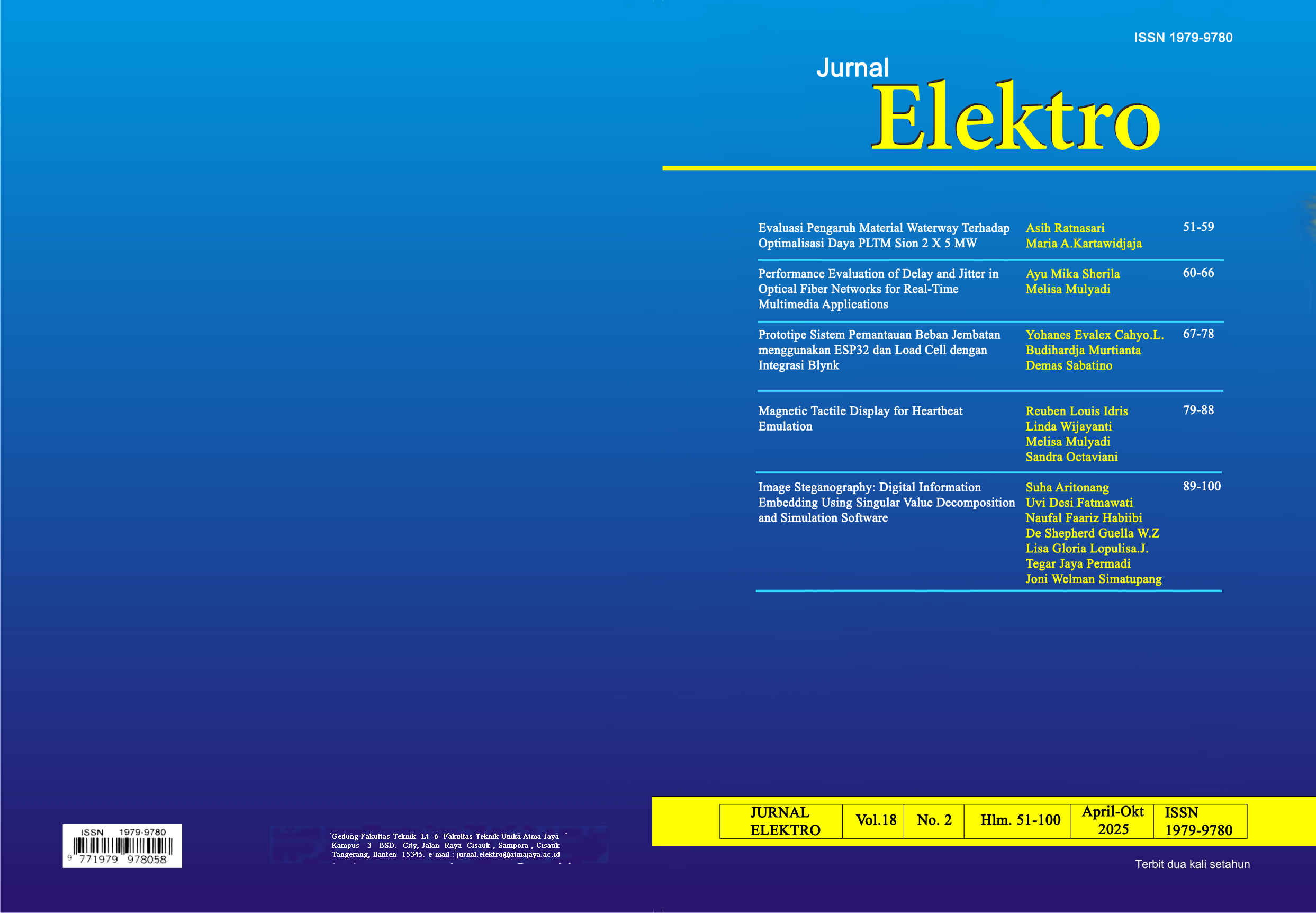
Performance Evaluation of Delay and Jitter in Optical Fiber Networks for Real-Time Multimedia Applications
DOI:
https://doi.org/10.25170/jurnalelektro.v18i2.7230Keywords:
Fiber Optic, Delay, Jitter, Quality of Service, Quality of Experience, VOIPAbstract
The increasing reliance on real-time services such as VoIP and video streaming underscores the critical role of fiber optic networks as high-capacity communication backbones. While optical fibers offer substantial bandwidth, this alone does not ensure optimal Quality of Experience (QoE); network delay and jitter remain prominent challenges that can disrupt audio clarity and video continuity. This paper presents a detailed analysis of delay and jitter phenomena within fiber optic systems, particularly emphasizing Passive Optical Network (PON) topologies. It explores the underlying causes of performance degradation from physical-layer limitations to architectural inefficiencies and critically assesses current mitigation techniques implemented at both the network level (e.g., Quality of Service mechanisms) and application level (e.g., jitter buffering strategies). The main contribution of this work is the introduction of a novel "Cross-Layer Performance Optimization Framework," which addresses the disconnect between static QoS enforcement and reactive application adaptations. By fostering dynamic interaction between the network and application layers, this framework aims to enable predictive control mechanisms that better safeguard user experience. Ultimately, this approach offers a pathway to more robust and efficient delivery of real-time services over next-generation optical access networks.
References
[1] A. A. El-Saleh, A. Alhammadi, I. Shayea, N. Alsharif, N. M. Alzahrani, O. I. Khalaf, dan T. H. H. Aldhyani, “Measuring and Assessing Performance of Mobile Broadband Networks and Future 5G Trends,” Sustainability, vol. 14, no. 2, pp. 829, 2022
[2] D. Chen, J. Xu, X. Tan, and M. Wu, “Study of an optical fiber time transmission method with real-time average temperature measurement of links,” Photonics, vol. 9, no. 5, p. 293, 2022.
[3] M. Ibrahimi, “Innovative cross-layer optimization techniques for the design of optical networks,” in Special Topics in Information Technology, F. Amigoni, Ed. Cham: Springer, 2024, pp. 1–10.
[4] T. N. Minhas and M. Fiedler, “Mitigation of the effects of network outage on video QoE using a sender buffer,” Electronics, vol. 10, no. 10, p. 1209, 2021.
[5] R. A. Butt, Z. A. Mahar, U. Habib, and M. I. Awad, “A G-DBA: A novel green dynamic bandwidth allocation algorithm for passive optical networks,” Opt. Fiber Technol., vol. 73, p. 103049, 2022.
[6] M. S. Hossain, A. Roy, and M. N. Islam, “Quality of service (QoS) enhancement in passive optical network (PON) through deep reinforcement learning-based dynamic bandwidth allocation,” Opt. Fiber Technol., vol. 77, pp. 103273, 2023.
[7] F. Azeem, A. Ali, and F. A. Khan, “A QoE-aware cross-layer SDN framework for multimedia traffic management in passive optical networks,” J. Netw. Comput. Appl., vol. 205, p. 103444, 2022.
[8] M. Shahin, M. Al-Quzweeni, and S. Nsaif, “AI-driven predictive bandwidth allocation for URLLC in 50G-PON,” Opt. Fiber Technol., vol. 83, p. 103632, 2024
[9] Y. Khlifi and F. A. Al-Zahrani, “Joint resource optimization and flexible QoS provision using hybrid optical core node architecture,” Heliyon, vol. 10, no. 2, p. e24058, 2024.
[10] B. García, F. Gortázar, M. Gallego, and A. Hines, “Assessment of QoE for video and audio in WebRTC applications using full-reference models,” Electronics, vol. 9, no. 3, p. 462, 2020.
[11] J. Lorincz, Z. Klarin, and D. Begusic, “Advances in improving energy efficiency of fiber–wireless access networks: A comprehensive overview,” Sensors, vol. 23, no. 4, p. 2239, 2023.
[12] Philipp et al., “Cross-layer optimization in PON systems for real-time services,” IEEE Commun. Lett., vol. XX, 2023.
[13] S. Ejaz et al., “A novel dynamic bandwidth allocation scheme towards improving the delay and jitter performance in PON,” Comput. Networks., vol. 224, p. 109451, 2022.
[14] M. Arpanaei et al., “Cross-layer QoE-aware framework for optical access networks,” SpringerBriefs in Applied Sciences and Technology. Cham, Switzerland: Springer, 2024.
[15] L. Alfieri et al., “Learning through project-based and inquiry-based learning approaches,” J. Educ. Psychol., vol. 118, no. 4, pp. 512–525, 2023.
[16] B. Skubic et al., “A comparison of dynamic bandwidth allocation for EPON, GPON and next-generation TDM-PON,” IEEE Communications Magazine, vol. 47, no. 3, pp. S40–S48, Mar. 2009, doi: 10.1109/MCOM.2009.4804388.
Downloads
Published
Issue
Section
License
Copyright (c) 2026 Ayu Mika Sherila, Melisa Mulyadi

This work is licensed under a Creative Commons Attribution 4.0 International License.