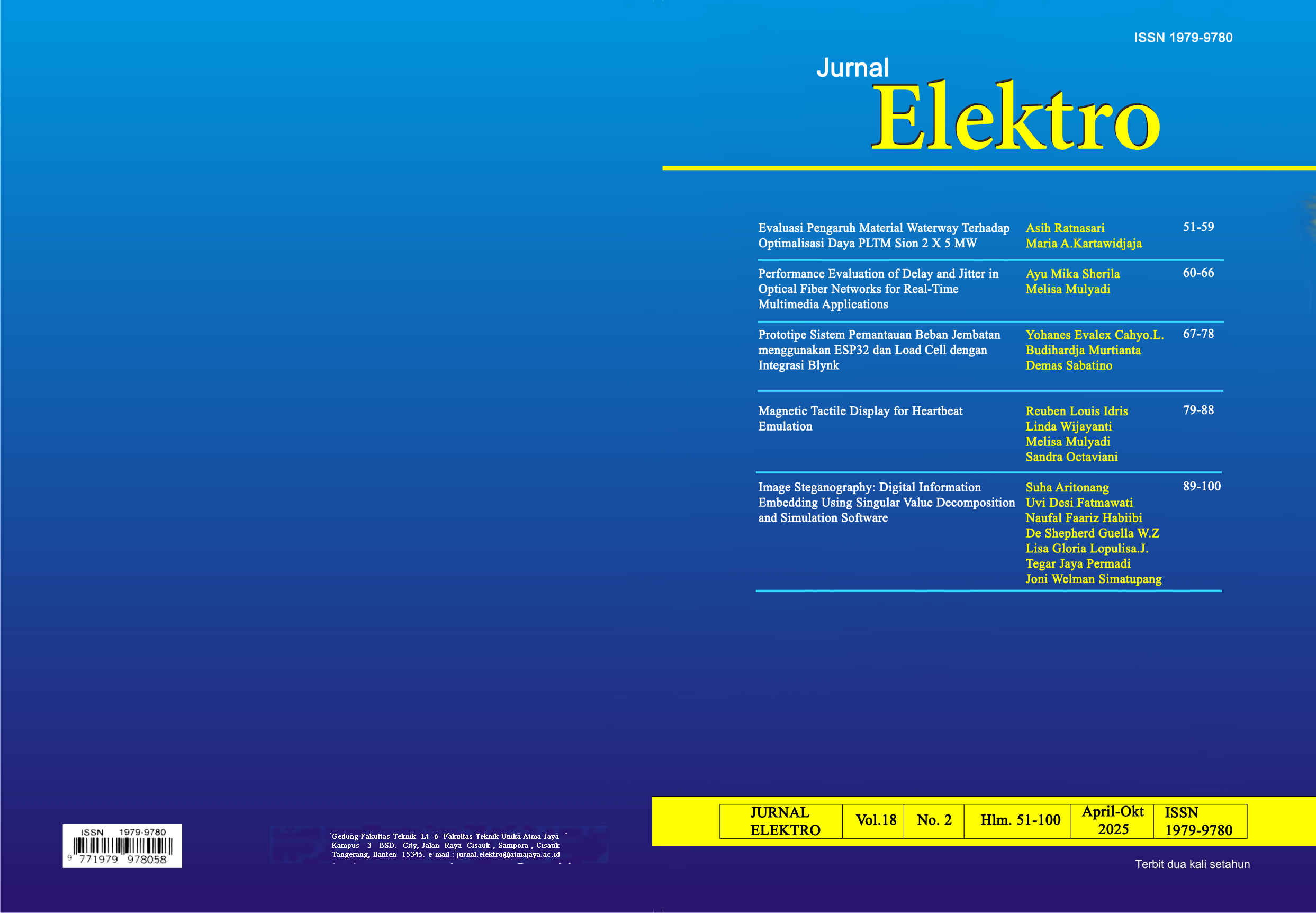
Magnetic Tactile Display for Heartbeat Emulation
DOI:
https://doi.org/10.25170/jurnalelektro.v18i2.7420Keywords:
Arduino Uno, ferrofluid, magnetic tactile display, heartbeat, humanoid robotAbstract
Recently, humanoid robots have developed rapidly and have the potential to become a medical innovation, enhancing human interaction. The ability to realistically mimic a heartbeat is a key feature under development. This research aims to design a ferrofluid-based magnetic tactile display to represent a heartbeat in a humanoid robot. This system utilizes an electromagnetic matrix, ferrofluid, and an Arduino Uno as a magnetic flield controller. Electrocardiogram (ECG) data is used to represent various heart rate patterns, such as normal, bradycardia, and tachycardia. The development results indicate that the magnetic tactile display is capable of providing tactile feedback that corresponds to the heart rate pattern. This device mimics heartbeats based on ECG data by controlling ferrofluid through magnetic field settings, allowing users to feel it tactilely. Testing using an accelerometer sensor shows that the system can replicate normal heartbeats and bradycardia with a small average time difference of 4.52% and 3.93%, respectively. However, in tachycardia, there were difficulties in handling rapid interval changes, resulting in a time error of 31.67%. The results of this study indicate that magnetic tactile displays have great potential in physiological emulation in humanoid robots.
References
[1] M. F. Fauzi, D. S. Devi, and I. Nazila, “Analisis Penilaian Kondisi Jembatan Ruas Jalan Peninggalan – Sei Lilin Dengan Metode Bridge Management System (BMS),” J. Deform., vol. 9, no. 1, pp. 60–66, 2024, doi: 10.31851/deformasi.v9i1.14394.
[2] M. A. Ridla and M. F. Rahman, “Perancangan Prototype Monitoring Suhu Berbasis Internet Of Things (IoT),” JUSIFOR J. Sist. Inf. dan Inform., vol. 3, no. 1, pp. 72–79, 2024, doi: 10.33379/jusifor.v3i1.4367.
[3] A. H. Widayatno, “Penggunaan Teknologi dalam Monitoring Ketahanan Struktur Jembatan,” Prodi Teknik Sipil, Sekolah Vokasi, Universitas Sebelas Maret, 2024. [Online]. Available: https://www.academia.edu/120937778
[4] A. ArjunPratikto, “Simulasi Kendali Dan Monitoring Daya Listrik Peralatan Rumah Tangga Berbasis ESP32,” ALINIER J. Artif. Intell. Appl., vol. 3, no. 1, pp. 38–48, 2022, doi: 10.36040/alinier.v3i1.4855.
[5] F. R. Firdaus, “Sistem Pemantauan Infus Mandiri Untuk Pasien Lansia Yang Menjalani Perawatan Rawat Jalan Berbasis Internet of Things (IoT),” p. 9, 2024.
[6] R. Hendrawan, A. S. Rohman, D. Hidayat, and T. Nugroho, “Sistem Monitoring Berat Pada Alat Organic Waste Chopper (Gasper) Dengan Sensor Berat (Load Cell) Berbasis Arduino Mega 2560,” Institut Teknologi Sumatera, 2020.
[7] L. Sabillah and R. Hidayat, “Sistem Monitoring Pemakaian Energi Listrik Pada Kamar Kost Menggunakan Aplikasi Blynk Berbasis Internet of Things,” J. Komput. dan Elektro Sains, vol. 1, no. 2, pp. 25–29, 2023, doi: 10.58291/komets.v1i2.104.
[8] S. D. D. Satria and R. P. Astutik, “Perancangan Sistem Monitoring Ketahanan Jembatan Berbasis Iot ( Internet Of Things ),” vol. 13, no. 1, 2025.
[9] E. W. Batubara and P. Sitompul, “Implementasi Fast Fourier Transform dalam Penyelesaian Persamaan Difusi Panas Satu Dimensi Universitas Negeri Medan , Indonesia,” no. 6, 2024.
[10] M. R. Sholahuddin and B. H. Kusuma, “Sistem Lampu Lalu Lintas Pintar untuk Kendaraan Prioritas,” vol. 4, pp. 633–640, 2025.
[11] Zulkarnain and Arman, “Potensi Internet of Things (IoT) Untuk Masa Depan Perkotaan Cerdas (Smart Cities),” J. Inf. Syst. Technol., vol. 06, no. 01, pp. 7–11, 2025, [Online]. Available: https://journal.uib.ac.id/index.php/joint/
[12] A. Fatah, U. Ungkawa, and M. M. Barmawi, “Implementasi Algoritma Fast Fourier Transform Pada Monitor Getaran Untuk Analisis Kesehatan Jembatan,” Infotronik J. Teknol. Inf. dan Elektron., vol. 5, no. 2, p. 48, 2020, doi: 10.32897/infotronik.2020.5.2.414.
[13] S. A. E. Mahendra, S. Subairi, N. Nachrowie, D. C. Permatasari, S. Sulistiyanto, and S. Fuada, “Implementasi Mikrokontroler ESP8266 sebagai Sensor Berat dan Jumlah Orang pada Beban Jembatan,” JASIEK (Jurnal Apl. Sains, Informasi, Elektron. dan Komputer), vol. 5, no. 1, pp. 17–24, 2023, doi: 10.26905/jasiek.v5i1.9950.
Downloads
Published
Issue
Section
License
Copyright (c) 2026 Reuben Louis Idris, Linda Wijayanti, Melisa Mulyadi, Sandra Octaviani

This work is licensed under a Creative Commons Attribution 4.0 International License.