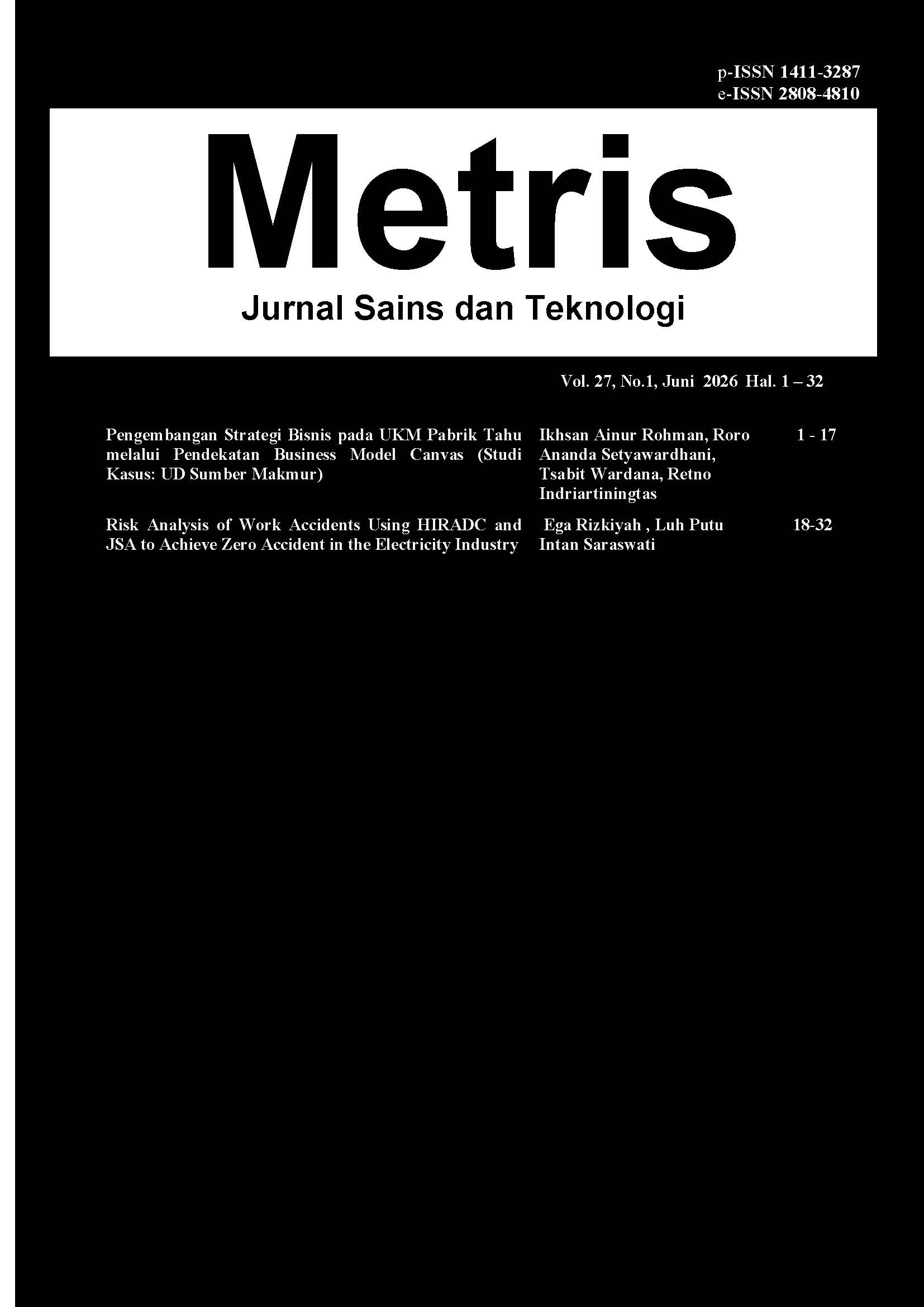
Risk Analysis of Work Accidents Using HIRADC and JSA to Achieve Zero Accident in the Electricity Industry
DOI:
https://doi.org/10.25170/metris.v27i01.7656Keywords:
Accident, Hazard, HIRADC, JSA, Risk Assessment, SafetyAbstract
Workplace accidents remain a serious problem across industrial sectors because they can lead to severe injuries, fatalities, and material losses. In Indonesia, workplace accident cases reached 356,383 as of October 2024, indicating the urgent need for more effective occupational safety risk control. This research identifies and analyzes occupational safety risks in the electricity industry, which is characterized by potential exposure to chemical, mechanical, ergonomic, and physical hazards. This research integrates Hazard Identification, Risk Assessment, and Determining Control (HIRADC) with Job Safety Analysis (JSA). HIRADC was used to identify, classify, and assess hazard levels across eight work areas, while JSA was applied to examine the most critical activity identified from the risk assessment results. Based on observations, interviews, and company reports in 2024, 498 findings were identified, of which 59% were negative findings caused by unsafe actions and unsafe conditions. The risk recapitulation showed that 76% of potential hazards were classified as high risk, 22% as moderate risk, and 2% as low risk. Area 2 recorded the highest average risk score of 9.20, while Area 4 had the largest number of hazards, with 10 findings and a maximum risk score of 12. Mechanical hazards were the most frequently identified hazard type, accounting for 18 findings, or 42.9% of the total hazards, whereas physical hazards had the highest average risk score of 8.90. The JSA results indicated that generator maintenance was the most critical activity because it involved multiple hazard types, including electrical, mechanical, physical, and chemical hazards. The proposed control measures were formulated based on the hierarchy of controls, particularly administrative controls and personal protective equipment. These findings suggest that integrating HIRADC and JSA can support electricity companies in identifying critical hazards, prioritizing preventive actions, and strengthening occupational safety management toward zero accident performance.
References
Albar, M. E., Parinduri, L., & Sibuea, S. R. (2022). Analisis Potensi Kecelakaan Menggunakan Metode Hazard Identification And Risk Assessment ( HIRA ). Buletin Utama Teknik, 17(3) 241-245.
Albrechtsen, E., Solberg, I., & Svensli, E. (2019). The application and benefits of job safety analysis. Safety Science, 113 (march 2019), 425–437.
Ameliawati, R. (2022). Penerapan Keselamatan dan Kesehatan Kerja dengan Metode HIRADC (Hazard Identification, Risk Assessment and Determining Control) di Area Plant-Warehouse Implementation of Occupational Safety and Health with The HIRADC (Hazard Identification, Risk Assessmen. Rang Teknik Journal, 6(1), 51–64.
4.
Ananda, D. Z., & Srisantyorini, T. (2025). HIRADC Analysis at PT Adhi Karya Mahata Serpong in 2025 . Jurnal Kajian dan Pengembangan Kesehatan Masyarakat, 5(2), 161–173.
Atirah, N., Ra, S., Alwi, W., Abdul, Z., Azri, A., & Kidam, K. (2022). Risk matrix approach of extreme temperature and precipitation for renewable energy systems in Malaysia. 254 (september), 124471.
Battini, D., Berti, N., Finco, S., Zennaro, I., & Das, A. (2022). Towards industry 5 . 0 : A multi-objective job rotation model for an inclusive workforce. International Journal of Production Economics, 250(August), 108619.
Dyreborg, J., Thorsen, S. V., Madsen, C. U., & Hasle, P. (2024). Effectiveness of OHSAS 18001 in reducing accidents at work. A follow-up study of 13,102 workplaces. Safety Science, 177(March), 106573.
Ejaz, M. F., Kilpeläinen, S., Mustakallio, P., & Zhao, W. (2024). An Experimental Study on the Efficacy of Local Exhaust Systems for the Mitigation of Exhaled Contaminants in a Meeting Room. Buildings 14(5), 1272
Faizah, N., Purnamawati, E., & Tranggono, T. (2021). Analisis Risiko K3 Pada Kegiatan Reparasi Kapal dengan Menggunakan Metode Hazard Identification, Risk Assessment and Determining Control (HIRADC) dan Metode Job Safety Analysis (JSA) pada PT. NF. Juminten, 2(5), 74–85.
Ghasemi, F., Doosti-Irani, A., & Aghaei, H. (2023). Applications, Shortcomings, and New Advances of Job Safety Analysis (JSA): Findings from a Systematic Review. Safety and Health at Work, 14(2), 153–162. https://doi.org/10.1016/j.shaw.2023.03.006
Gonyora, M., & Ventura-medina, E. (2024). Investigating the relationship between human and organisational factors , maintenance , and accidents . The case of chemical process industry in South Africa. Safety Science, 176(April), 106530.
Hisam, A., Mashhadi, S., Saqib, A., Naveed, M., Sadiq, M., Imtiaz, T., & Ashraf, A. (2023). Biological, physical, ergonomic, chemical and psychological hazard awareness among health care and non-healthcare workers. Pakistan Armed Forces Medical Journal, 72(SUPPL-4), S908–S913.
Husnaseptia, F., Andivas, M., & Harits, D. (2024). Analisis Potensi Bahaya pada Kalibrasi Metering System Menggunakan Metode JSA. Jurnal Surya Teknika. 11(2), 544–549.
Jogie, J. A., Rampersad, D., Bharrath-singh, D., Joseph, S., & Clarke, A. (2025). A Comprehensive Review of the Hierarchy of Controls and Barriers to its Implementation. International Journal of Preventive Medicine and Health (IJPMH), 5(3), 32–38. https://doi.org/10.54105/ijpmh.C1061.05030325
Lazuardi, M. R., Sukwika, T., & Kholil, K. (2022). Analisis Manajemen Risiko Keselamatan dan Kesehatan Kerja Menggunakan Metode HIRADC pada Departemen Assembly Listrik. Journal Of Applied Management Research (JAMR), 1, 11–20.
Lee, C., Lu, S., & Wu, C. (2022). Rest period and object load effects on upper limb muscle strength recovery for manual load transfer. International Journal of Industrial Ergonomics, 89(110), 103274.
Majano, D. (2026). Workplace Injury & Fatality Statistics. Electrical Safety Foundation Internasional. https://www.esfi.org/workplace-safety/workplace-injury-fatality-statistics/. Diakses tanggal 12 Mei 2026
Milošević, I., Stojanović, A., Nikolić, Đ., Mihajlović, I., Brkić, A., Perišić, M., & Spasojević-Brkić, V. (2025). Occupational health and safety performance in a changing mining environment: Identification of critical factors. Safety Science, 184(April), 106745.
Mura, M. D., & Dini, G. (2023). Improving ergonomics in mixed-model assembly lines balancing noise exposure and energy expenditure. CIRP Journal of Manufacturing Science and Technology, 40, 44–52.
Oktavia, E., & Fauziah, M. (2025). Gambaran Job Safety Analysis Survey Jalur Instalasi Outdoor di Biznet Cirendeu Tahun. Jurnal Ilmu Kesehatan Umum, Psikolog, Keperawatan dan Kebidanan 3(3),219-225.
Pamungkas, I., Khaleil, A., & Tri, H. (2025). Hazard Identification and Risk Management for Occupational Safety and Health at PT . PLN ( Persero ) Transmisi dan Gardu Induk Meulaboh. Jurnal Inovasi Teknologi dan Rekayasa 10(1), 83–89.
Delpla, V., Delpla, V., Chapron, K., Kenné, J., Hof, L., Hof, L., & Delpla, V. (2022). Towards intelligent manufacturing system Towards intelligent manufacturing system safety strategies : Generating LockOut / TagOut sheets by Machine Learning study- acase study. IFAC PapersOnLine, 55(10), 1001–1006.
32 Rizkiyah & Saraswati / Metris: Jurnal Sains dan Teknologi 27 (2026) 18-32
Rajkumar, I., Subash, K., Raj Pradeesh, T., Manikandan, R., & Ramaganesh, M. (2021). Job safety hazard identification and risk analysis in the foundry division of a gear manufacturing industry. Materials Today: Proceedings, 46, 7783–7788.
Sadeghi-yarandi, M., Torabi-gudarzi, S., & Asadi, N. (2023). Development of a novel Electrical Industry Safety Risk Index ( EISRI ) in the electricity power distribution industry based on fuzzy analytic hierarchy process ( FAHP ). Heliyon, 9(2), e13155.
Sánchez-Lite, A., Fuentes-Bargues, J. L., Iglesias, I., & González-Gaya, C. (2024). Proposal of a workplace classification model for heart attack accidents from the field of occupational safety and health engineering. Heliyon, 10(18).
Van Derlyke, P., Marín, L. S., & Zreiqat, M. (2022). Discrepancies Between Implementation and Perceived Effectiveness of Leading Safety Indicators in the US Dairy Product Manufacturing Industry. Safety and Health at Work, 13(3), 343–349.
Viswanathan, K., Johnson, M. S., & Toffel, M. W. (2024). Do safety management system standards indicate safer operations? Evidence from the OHSAS 18001 occupational health and safety standard. Safety Science, 171(march), 106383.
Vukicevic, A. M., Djapan, M., Isailovic, V., & Milasinovic, D. (2022). Generic compliance of industrial PPE by using deep learning techniques. Safety Science, 148(April), 105646.
Wong, K. P., & Meng, X. (2024). A Bibliometric and Scientometric Network Analysis of Occupational Safety and Health in the Electric Power Industry : Future Implication of Digital Pathways, Sustainability. 16(13),2-28
Zainul, L. M., Pongky, P., Dhea, A., & Syams, N. (2025). Kajian Risiko Keselamatan Kerja Pada Pekerjaan Instalasi Panel Listrik : Pendekatan Job Safety Analysis Di Pt . Meica Indo Teknik, Jurnal Ilmiah Keselamatan Kesehatan Kerja dan Lindungan Lingkungan, 11(4),1229–1233.