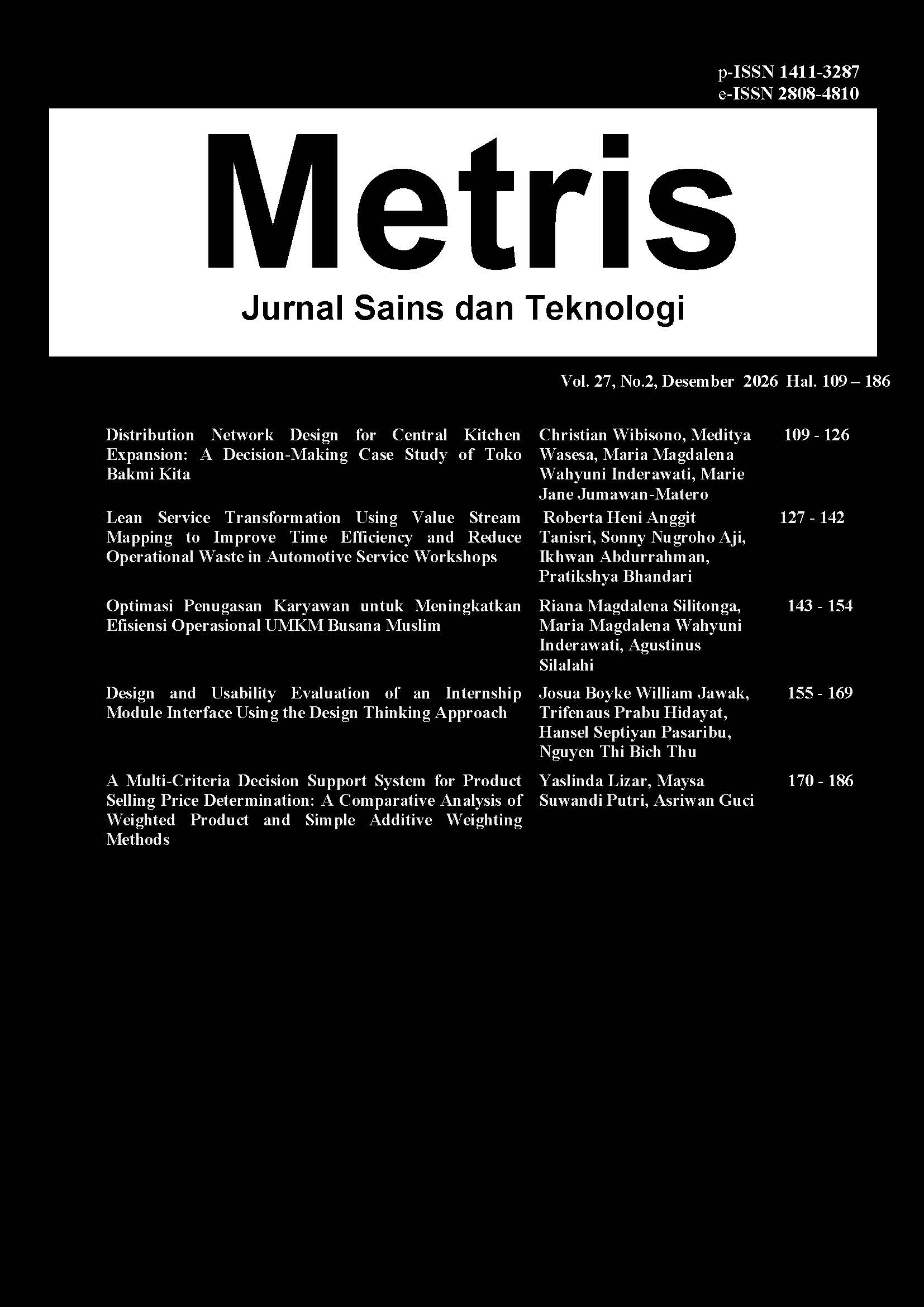
A Multi-Criteria Decision Support System for Product Selling Price Determination: A Comparative Analysis of Weighted Product and Simple Additive Weighting Methods
DOI:
https://doi.org/10.25170/metris.v27i02.8057Keywords:
Decision Support System, Multi-Criteria Decision Makin, Product Selling Pric, Weighted Produc, Simple Additive Weighting, Retail BusinessAbstract
Determining an appropriate product selling price is a critical decision in retail business because it directly affects profitability, market competitiveness, and business sustainability. However, small retail businesses often rely on subjective judgment and manual calculations, which can lead to inconsistent pricing decisions when multiple factors must be considered simultaneously. This study develops a Multi-Criteria Decision Support System to determine product selling prices by comparatively applying the Simple Additive Weighting (SAW) and Weighted Product (WP) methods. Five decision criteria were considered: Product Acquisition Cost, Product Quality, Market Demand, Operational Cost, and Expected Profit. The proposed approach was implemented at the Yeni Mode Retail Store, with five product alternatives evaluated using identical criteria and weighting schemes. The results show that both methods produced an identical ranking order, with Jeans (A3) achieving the highest priority, followed by Shirt (A2), Blouse (A5), Muslim Dress (A1), and Women's Skirt (A4). The SAW method yielded a preference score of 0.868 for the highest-ranked alternative, whereas WP yielded 0.220. Despite differences in their additive and multiplicative aggregation mechanisms, both methods demonstrated consistent decision outcomes. SAW offers advantages in computational simplicity and ease of interpretation, whereas WP provides an alternative mechanism for representing proportional relationships among criterion values. The proposed system provides a systematic, transparent, and data-driven approach to supporting product pricing decisions and can help retail business owners reduce reliance on subjective judgment when evaluating multiple pricing factors.
References
Abdel-Basset, M., Gamal, A., Chakrabortty, R. K., Ryan, M. (2021). A new hybrid multi-criteria decision-making approach for location selection of sustainable offshore wind energy stations: A case study, Journal of Cleaner Production, 280, (2), 124462,
Ali, R., Hussain, A., Nazir, S., Khan, S., & Khan, H. U. (2023). Intelligent Decision Support Systems—An Analysis of Machine Learning and Multicriteria Decision-Making Methods. Applied Sciences, 13(22), 12426.
Alosta, A., Elmansuri, O., & Badi, I. (2021). Resolving a location selection problem by means of an integrated AHP-RAFSI approach. Reports in Mechanical Engineering, 2(1), 135–142.
Dhurkari, R. (2022). Strategic pricing decision using the analytic hierarchy process. Journal of Revenue and Pricing Management. 22. 85–100.
Hamdan, M. R., Triayudi, A., & Iskandar, A. (2022). Komparasi Metode Simple Additive Weighting dan Weighted Product Menggunakan Sistem Pendukung Keputusan pada Penerimaan BLT. JURIKOM (Jurnal Riset Komputer), 9(5), 1543-1550.
Kostopoulos, G., Davrazos, G., & Kotsiantis, S. (2024). Explainable Artificial Intelligence-Based Decision Support Systems: A Recent Review. Electronics, 13(14), 2842.
Kotler, P., Keller, K. L., & Chernev, A. (2022). Marketing management (16th ed.). Pearson.
Kovari, A. (2024). AI for Decision Support: Balancing Accuracy, Transparency, and Trust Across Sectors. Information, 15(11), 725.
Poonguzhali, S., Arora, N., Majid, A., Mishra, D., Sahoo, S.K., Pramanik, S., Khan, S. K. N. (2026). Artificial Intelligence and Intelligent Decision Support Systems: Emerging Trends and Applications in Computer Science. Journal of Intelligent Decision Making and Information Science, 3 (75), 2339–2355.
Phillips-Wren, G., Daly, M., & Burstein, F. (2021). Reconciling business intelligence, analytics and decision support systems: More data, deeper insight. Decision Support Systems, 146, 113560.
Sazaki, Y., Efendi, R., & Jambak, M. I. (2023). Analisis komparatif metode Weighted Product (WP) dan metode Simple Additive Weighting (SAW). Jurnal Pendidikan Sains dan Komputer, 3(2),215
Sharda, R., Delen, D., & Turban, E. (2020). Analytics, data science, & artificial intelligence: Systems for decision support (11th ed.). Pearson.
Simanungkalit, E., Tarigan, J. S., Sari, D. C., & Hasibuan, A. S. (2023). Implementation of the Simple Additive Weighting (SAW) method in a decision support system to determine the best university in Medan. International Journal of Research in Vocational Studies (IJRVOCAS), 2(4), 168–172.
Sutoyo, M. N. (2024). Komparatif metode Simple Additive Weighting (SAW) dan Weighted Product (WP) dalam sistem pendukung keputusan. Bianglala Informatika, 12(2), 88–94.
Wahyuddin; Kautsar, A.; Darpi; Nurhayati; Sawitri. (2025). Komparasi Metode Simple Additive Weighting, Weight Product, dan Topsis Dalam Penentuan Keputusan. Jurnal Riset Sistem Informasi dan Teknologi Informasi (JURSISTEKNI), 7(2), 788–797.