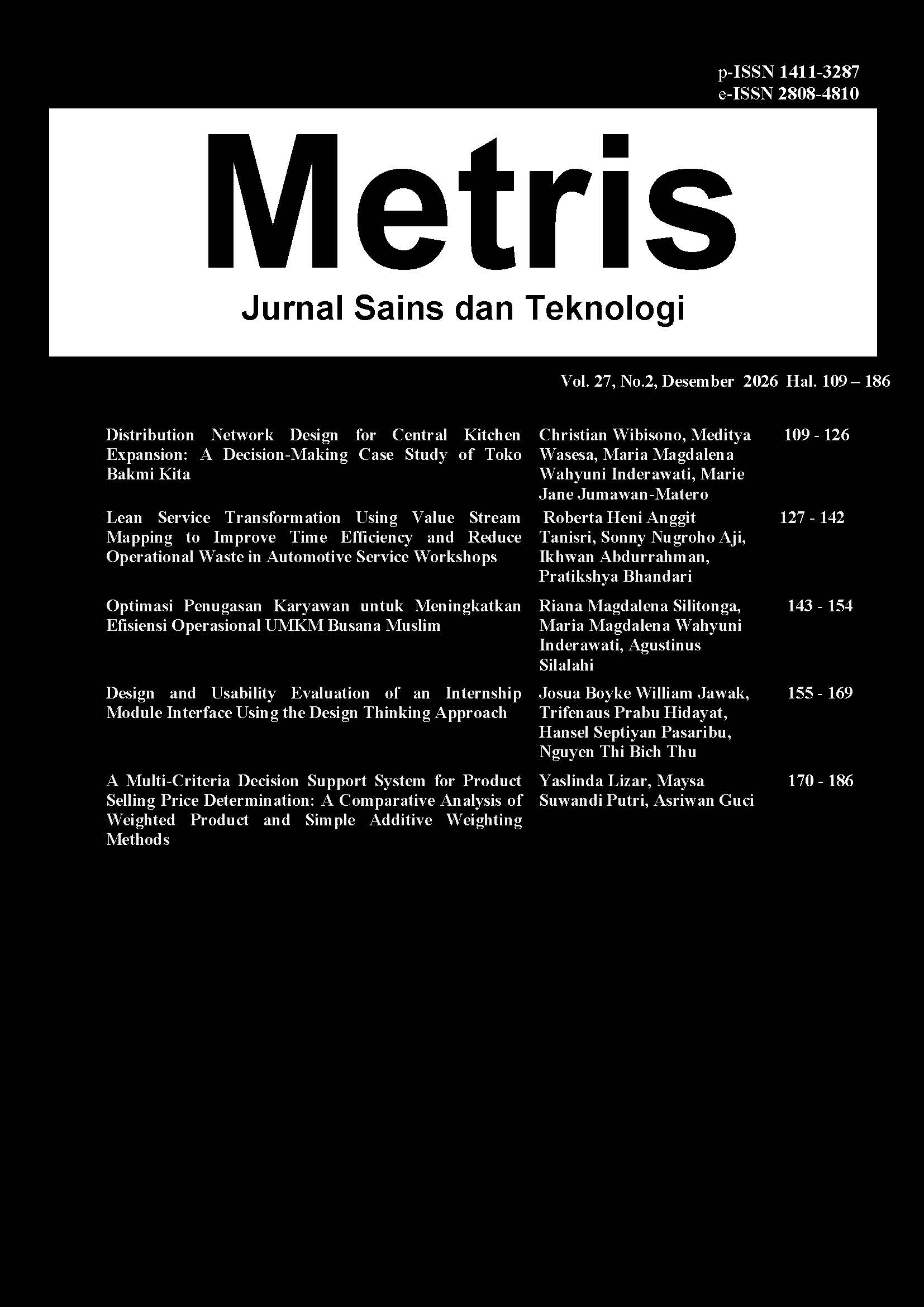
Optimasi Penugasan Karyawan untuk Meningkatkan Efisiensi Operasional UMKM Busana Muslim
DOI:
https://doi.org/10.25170/metris.v27i02.8119Keywords:
operational efficiency, assignment method, workforce allocation, SMEs, Muslim fashion industry, OptimizationAbstract
Operational efficiency is a key determinant of success for Muslim fashion SMEs in navigating increasingly competitive digital industries. This study aims to identify the most optimal employee assignment combination at XYZ, a Muslim fashion SME, using the assignment method within Operations Research. The problem addressed is the current task distribution, which does not adequately consider employees’ specific competencies, potentially reducing productivity and operational efficiency. This research adopts a descriptive quantitative approach using secondary data arranged in a 4×4 assignment matrix. The matrix involves four employees—Alya, Bella, Citra, and Dinda—and four main operational activities: customer service, order packing, content creation, and live selling. Data processing was conducted using the assignment module in POM-QM for Windows version 12.3, applying a total time minimization approach. The optimization results indicate that the best assignment is Alya in customer service (18 minutes), Bella in order packing (20 minutes), Citra in content creation (16 minutes), and Dinda in live selling (15 minutes), resulting in a minimum total time of 69 minutes. Compared to a random assignment scenario with a total time of 124 minutes, the application of the Assignment method achieves a time savings of 44.35%. These findings demonstrate that the assignment method is an effective decision-making tool for competency-based task allocation, contributing to improved operational efficiency, enhanced workforce productivity, and stronger competitiveness of Muslim fashion SMEs in the digital era.
References
Aryata, I. M., & Marendra, I. G. (2022). Decision making strategy using the assignment method with the POM-QM Application. Jurnal Pengabdian Masyarakat Bestari, 1(8), 747-758.
Azhara, F., Ananda, M. G. T., Ramadhani, A., & Tanjung, A. A. (2025). Analisis implementasi metode EOQ pada sistem pengendalian persediaan bahan baku berbasis POM-QM. Journal of Information Systems and Technology, 2(2), 90-99.
Bogomolnaia, A., & Moulin, H. (2001). A new solution to the random assignment problem. Journal of Economic Theory, 100(2), 295–328.
Fadillah, M., Ramadhan, H. M., Hidayat, T., Sahrin, L. A., Alfian, M. R., & Maharani, A. E. S. H. (2024). Optimasi keuntungan penjualan dengan metode Simpleks: implementasi menggunakan software POM-QM. Jurnal Sains Natural, 2(4), 134-140.
Faudzi, S., Abdul-Rahman, S., & Abd Rahman, R. (2018). An assignment problem and its application in education domain: A review and potential path. Advances in operations research, 2018(1), 8958393.
Gultom, P., & Banjarnahor, R. T. (2025). Penerapan metode penugasan Hungarian dalam penyelesaian masalah maksimasi. Jurnal Ilmiah Ekonomi Dan Manajemen, 3(6), 477-486.
Hidayat, N., Febrian, M. R., & Yusuf, S. (2025). Analisis peramalan volume penjualan CV Tirta Anugerah Abadi menggunakan metode exponential smoothing with trend pada POM-QM. Master Manajemen, 3(2), 138-147.
Hillier, F.S. & Lieberman, G.J. (2015). Introduction to Operations Research. New York: McGraw-Hill.
Hukom, C. A., Tewu, D., & Gunawan, I. (2025). Optimization of employee performance cost risk management with the Hungarian method using POM QM Software on XYZ MSMEs. Jurnal Akuntansi Keuangan dan Manajemen, 6(2), 485-496.
Nurfauzia, F., & Rizqiya, S. (2023). Reorder point analysis on Fasajaya wholesale store inventory using POM QM application. JOBM-Journal of Business Management Basic, 5(2), 121-126.
Parningotan, S., & Pangastuti, N. (2022). Analisis penugasan karyawan dalam meningkatkan produktivitas kerja menggunakan metode Hungarian pada software POM QM dengan Kasus Maksimasi. Jurnal Ilmiah Sistem Informasi, 2(1), 22-32.
Pratama, A. A., Fabiola, D., Surya, M. H., Jun, S., Marselina, T., & Effendy, D. (2024). Optimasi produksi Takoyabox menggunakan metode Simplex Linear Programming dengan software POM-QM. Jurnal Inovasi Bisnis Manajemen dan Akuntansi, 2(4), 312-327.
Puspasari, D., & Rusli, Y. D. (2023). Application of raw material inventories using the abc class classification method and the EOQ method in raw material inventories based on POM QM For Windows:Case Study on Surabi Gapura Purwakarta. Transformasi: Journal of Economics and Business Management, 2(3), 50-62.
Rianse, U., Taufik, Y., & Herdhiansyah, D. (2023). Forecasting model of corn commodity productivity in indonesia: production and operations management, quantitative method (POM-QM) software. International Journal of Advanced Computer Science and Applications, 14(5), 611-617.
Rumetna, M. S., Lina, T. N., Rieuwpassa, H. S., Tindage, J., & Matahelumual, F. (2023). Pelatihan penerapan aplikasi POM-QM untuk optimalisasi hasil penjualan petatas pada UKM Saleh. ABDIKAN: Jurnal Pengabdian Masyarakat Bidang Sains Dan Teknologi, 2(2), 270-279.
Saragih, R. J. P., Manalu, J. K., & Gultom, P. (2026). Aplikasi metode penugasan (assignment model) dalam optimasi alokasi staf divisi karyawan baru guna meminimalkan waktu penyesuaian. Jurnal Akademik Ekonomi dan Manajemen, 3(3), 604-617.
Sindar, A., & Zendrato, R. N. (2019). Optimasi penugasan pegawai menggunakan metode Hungarian. Journal of Innovation Information Technology and Application (JINITA), 1, 16-24.
Singh, S., Dubey, G. C., & Shrivastava, R. (2012). A comparative analysis of assignment problem. IOSR Journal of Engineering, 2(8), 1–5.
Spivey, M. Z., & Powell, W. B. (2004). The dynamic assignment problem. Transportation Science, 38(4), 399–419.
Yasri, B., Harefa, F. M., Fadila, M., Ananda, N., & Ginting, S. S. B. (2025). Penerapan program linier untuk menyelesaikan masalah alokasi sumber daya pada persoalan penugasan. Algoritma: Jurnal Matematika, Ilmu pengetahuan Alam, Kebumian dan Angkasa, 3(4), 82-88.