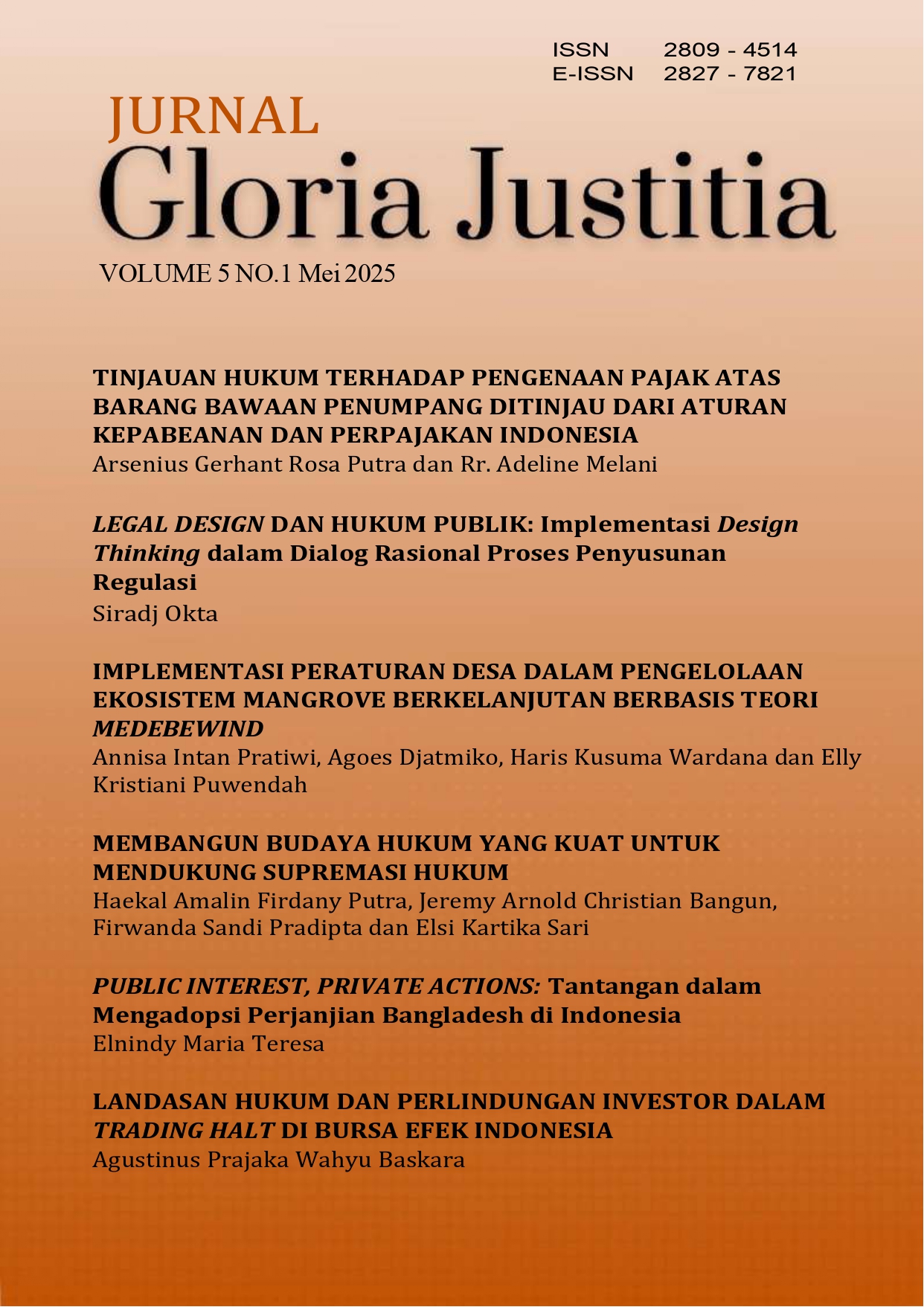
LEGAL DESIGN DAN HUKUM PUBLIK: IMPLEMENTASI DESIGN THINKING DALAM DIALOG RASIONAL PROSES PENYUSUNAN REGULASI
DOI:
https://doi.org/10.25170/gloriajustitia.v5i1.6694Keywords:
Legal Design, Legal Process Theory, Public Law, Regulation, Design ThinkingAbstract
Legal design adalah pendekatan inovatif yang menggabungkan prinsip desain dengan hukum, bertujuan untuk menjadikan hukum lebih mudah dipahami, inklusif, dan efektif. Pada konteks hukum publik, pendekatan ini semakin relevan untuk menjawab tantangan regulasi yang kompleks dan sulit diakses oleh masyarakat. Artikel ini mengkaji bagaimana metode design thinking—melalui tahapan empati, perumusan masalah, ideasi, prototipe, dan pengujian—dapat diintegrasikan dalam proses legislasi dan perumusan kebijakan publik. Penelitian ini menggunakan metode studi literatur dan studi kasus penerapan legal design oleh Pemerintah Finlandia. Berdasarkan kerangka teori hukum sebagai proses (legal process theory), tulisan ini menekankan pentingnya partisipasi publik, keterbacaan, dan uji coba regulatif sebagai bagian dari proses hukum yang deliberatif. Legal design dapat meningkatkan legitimasi, akuntabilitas, dan efektivitas hukum publik dengan menempatkan warga negara sebagai pengguna utama regulasi.
References
1. Buku
Douzinas, Costas & Lynda Nead (eds.), Law and the Image: The Authority of Art and the Aesthetics of Law, (Chicago: University of Chicago Press, 1999).
Fuller, Lon L., The Morality of Law, Revised Edition, (New Haven: Yale University Press, 1969).
Goodrich, Peter, Legal Emblems and the Art of Law: Obiter Depicta as the Vision of Governance, (Cambridge: Cambridge University Press, 2014).
Hagan, Margaret, Law By Design, (Stanford: d.school, 2016).
Sherwin, Richard K., Visualizing Law in the Age of the Digital Baroque: Arabesques & Entanglements, (New York: Routledge, 2011).
2. Artikel/ Jurnal
Berger-Walliser, Gerlinde, “The Future of Contracting: Smart Contracts and Visual Law,” American Business Law Journal, 55(3), 2018.
Haapio, Helena, “Next Generation Contracts: A Paradigm Shift in Contract Design,” Journal of Contract Law Reform, 12(1), 2018.
Haapio, Helena & Stefania Passera, “Visualizing Contracts for Better Business,” Journal of Business Law, 10(2), 2021.
Waller, Rob, “Plain Language in Government Contracts: The Finnish Approach,” International Journal of Law and Language, 15(1), 2019.
3. Internet
Singapore Academy of Law, “Legal Tech Vision and Innovation Initiatives,” sebagaimana dimuat dalam https://www.sal.org.sg/Resources-Tools/Legal-Tech, diakses pada April 2025.
4. Lainnya
Passera, Stefania, et al., Legal Design for Government: Towards User-Centric Legal Systems, (Helsinki: Helsinki Design Lab, 2017).
Wawancara penulis dengan praktisi hukum di Jakarta, Februari 2025.
Downloads
Published
Issue
Section
License
You are free to:
- Share — copy and redistribute the material in any medium or format for any purpose, even commercially.
- Adapt — remix, transform, and build upon the material for any purpose, even commercially.
- The licensor cannot revoke these freedoms as long as you follow the license terms.
Under the following terms:
- Attribution — You must give appropriate credit, provide a link to the license, and indicate if changes were made. You may do so in any reasonable manner, but not in any way that suggests the licensor endorses you or your use.
- ShareAlike — If you remix, transform, or build upon the material, you must distribute your contributions under the same license as the original.
- No additional restrictions — You may not apply legal terms or technological measures that legally restrict others from doing anything the license permits.
Notices:
You do not have to comply with the license for elements of the material in the public domain or where your use is permitted by an applicable exception or limitation.
No warranties are given. The license may not give you all of the permissions necessary for your intended use. For example, other rights such as publicity, privacy, or moral rights may limit how you use the material.