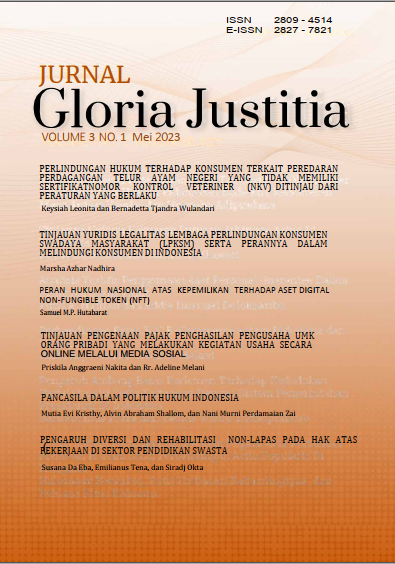
PENGARUH DIVERSI DAN REHABILITASI NON-LAPAS PADA HAK ATAS PEKERJAAN DI SEKTOR PENDIDIKAN SWASTA
DOI:
https://doi.org/10.25170/gloriajustitia.v3i1.4421Keywords:
Diversi, Rehabilitasi, Hak atas PekerjaanAbstract
Former inmates who have completed their sentences and have been declared free, which includes any individual, face significant challenges in securing employment to meet their livelihood needs. The same situation applies to individuals who have undergone non-prison rehabilitation for drug abuse. Parallel to the experiences of former inmates and non-prison rehabilitation, the concept of diversion has been introduced for juvenile offenders who are prospective job applicants. Both diversion and non-prison rehabilitation share the characteristic that the suspected perpetrators of criminal acts do not undergo punishment through the usual criminal justice system. However, these individuals still face stigma and difficulties similar to those encountered by former inmates in general. This study aims to explore the comparative impact of diversion and non-prison rehabilitation in relation to the right to employment. Specifically, the study focuses on a comparison within the private education sector. Using a comparative approach, this research seeks to provide a sharper perspective on diversion and non-prison rehabilitation as features of modern criminal law in Indonesia. The study finds that within the private education sector, diversion and non-prison rehabilitation offer a more favorable framing for the subjects, supported by philosophical factors inherent in private educational institutions. Policies implemented by the private education sector play a crucial role in ensuring the preservation of the right to employment by educational institutions.
Downloads
Published
Issue
Section
License
You are free to:
- Share — copy and redistribute the material in any medium or format for any purpose, even commercially.
- Adapt — remix, transform, and build upon the material for any purpose, even commercially.
- The licensor cannot revoke these freedoms as long as you follow the license terms.
Under the following terms:
- Attribution — You must give appropriate credit, provide a link to the license, and indicate if changes were made. You may do so in any reasonable manner, but not in any way that suggests the licensor endorses you or your use.
- ShareAlike — If you remix, transform, or build upon the material, you must distribute your contributions under the same license as the original.
- No additional restrictions — You may not apply legal terms or technological measures that legally restrict others from doing anything the license permits.
Notices:
You do not have to comply with the license for elements of the material in the public domain or where your use is permitted by an applicable exception or limitation.
No warranties are given. The license may not give you all of the permissions necessary for your intended use. For example, other rights such as publicity, privacy, or moral rights may limit how you use the material.