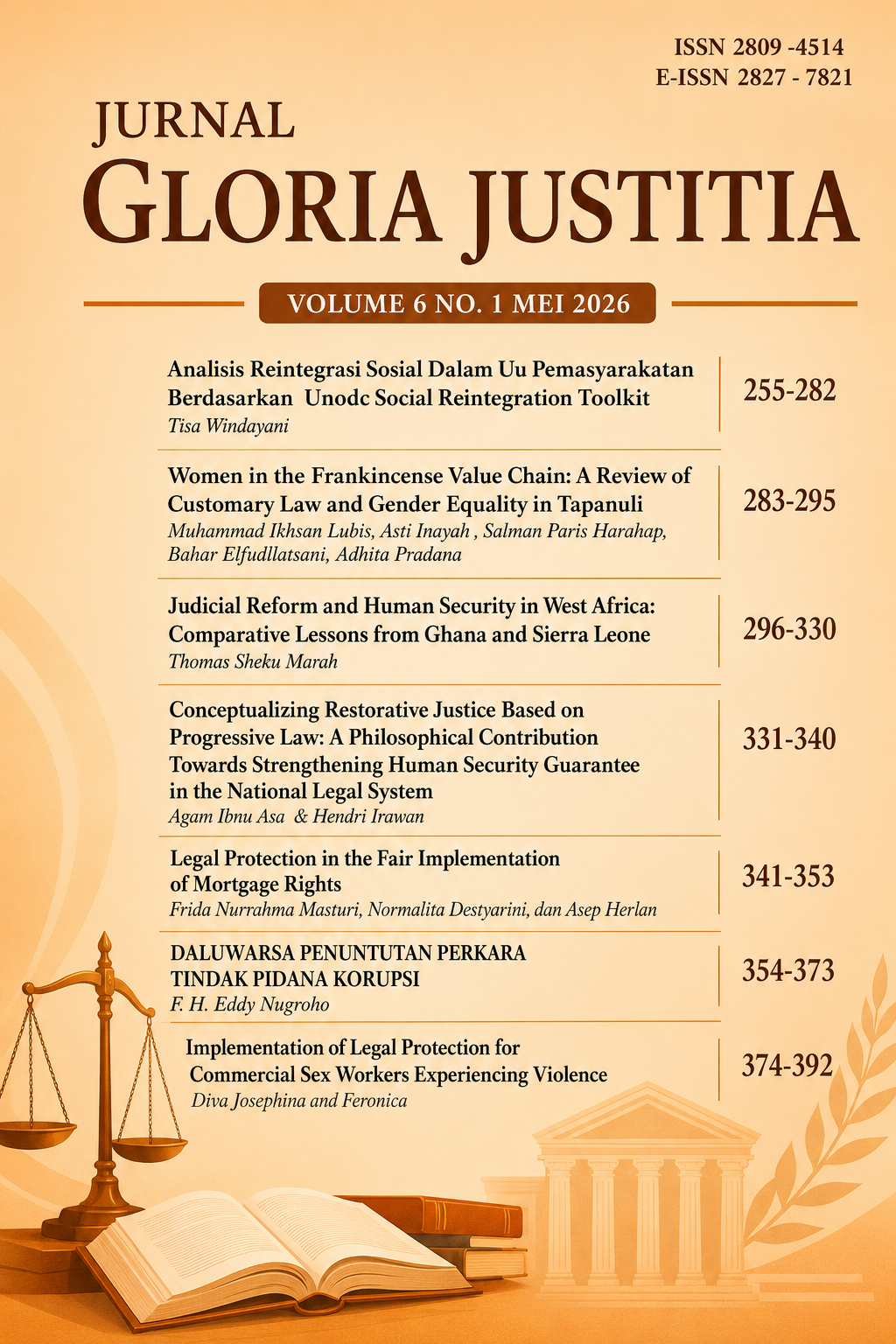
Legal Protection in the Fair Implementation of Mortgage Rights
DOI:
https://doi.org/10.25170/gloriajustitia.v6i1.7904Keywords:
Legal Protection, Mortgage Rights, Principles of Balance, Good FaithAbstract
This research aims to analyze the application of the principles of balance and good faith in the enforcement of mortgage rights, with a particular focus on ensuring proportional legal protection for debtors. Although the Mortgage Law provides legal certainty for creditors, execution practices frequently disadvantage debtors, especially regarding auction pricing, notification mechanisms, and creditor conduct in determining default. Using a normative juridical method with statutory and conceptual approaches, this study finds that debtor protection should not merely rely on formal declarations of default, but must also consider factual conditions, including force majeure circumstances and the debtor’s good faith. The implementation of procedural transparency, objective pre-execution mechanisms, and the principle of balance is essential to prevent abuse of rights by creditors and to ensure that execution serves as a last resort. Therefore, harmonizing legal certainty, justice, and utility is indispensable to create a fair legal relationship between creditors and debtors in the execution of mortgage rights.
References
B, E., & Gunawan, H. (2022). Perlindungan Hukum Terhadap Debitur Perorangan Atas Hilangnya Objek Jaminan Fidusia Pada Saat Kreditur Telah Berganti Karena Pelaksanaan Pengalihan Hak Atau Cessie. Jurnal Yustisiabel. https://doi.org/10.32529/yustisiabel.v6i2.1879
Firdaus, A. F. N., Aina, I., Ridhotullah, M. V., & Sinwani. (2025). Problematika Eksekusi Hak Tanggungan Dalam Perbankan Syariah Terhadap Efektifitas Pasal 20 Uuht. Jurnal Media Akademik (Jma), 3(6).
Ginting, L. (2016). Perlindungan Hukum Bagi Kreditor Yang Beritikad Baik Akibat Pembatalan Hak Tanggungan. De Lega Lata, 1(2), 368–391.
Hardiyansyah, T., & Tjempaka, T. (2025). Legal Protection for Debtors Acting in Good Faith in Fulfilling Obligations To Unidentified Creditors. Awang Long Law Review, 7(2), 368–375. https://doi.org/10.56301/awl.v7i2.1555
Isradjuningtias, A. C. (2015). Force Majeure (Overmacht) Dalam Hukum Kontrak (Perjanjian) Indonesia. Veritas et Justitia. https://doi.org/10.25123/vej.1420
Khalid, A. (2023). ANALISIS ITIKAD BAIK SEBAGAI ASAS HUKUM PERJANJIAN. Jurnal Legal Reasoning. https://doi.org/10.35814/jlr.v5i2.4644
Meher, M., Sirait, N., & Ginting, L. (2019). Protection for Parties Involved in A Bank Credit Agreement with the Principles of Balance and Good Faith. https://doi.org/10.4108/eai.26-1-2019.2283204
Prasetyo, B., Hartana, H., & Nyoman Tio Rae, G. (2024). Perlindungan Hukum terhadap Debitur Pemilik Jaminan dalam Penyelesaian Sengketa Lelang Hak Tanggungan Apabila Kreditur Beritikad Tidak Baik. Jurnal Global Ilmiah, 2(2), 893–900. https://doi.org/10.55324/jgi.v2i2.140
Priyanto, A., Heryanti, B. R., & -, M. (2016). Analisis Proses Eksekusi Hak Tanggungan Terhadap Jaminan Kebendaan Tidak Bergerak Berdasarkan Undang- Undang Hak Tanggungan. Hukum Dan Masyarakat Madani. https://doi.org/10.26623/humani.v6i2.949
Safira Meisya Salsa Bina. (2023). Asas Keseimbangan Dalam Hukum Perjanjian. JOURNAL SAINS STUDENT RESEARCH. https://doi.org/10.61722/jssr.v1i2.324
Tjoanda, M., Hetharie, Y., Pariela, M. V. G., & Sopamena, R. F. (2021). Covid-19 Sebagai Bentuk Overmacht dan Akibat Hukumnya Terhadap Pelaksanaan Perjanjian Kredit. SASI. https://doi.org/10.47268/sasi.v27i1.447
Widiasari, H. (2018). Perlindungan Hukum Bagi Para Pihak Dalam Perjanjian Kredit Dengan Jaminan Hak Taggungan. Res Judicata. https://doi.org/10.29406/rj.v1i2.1233