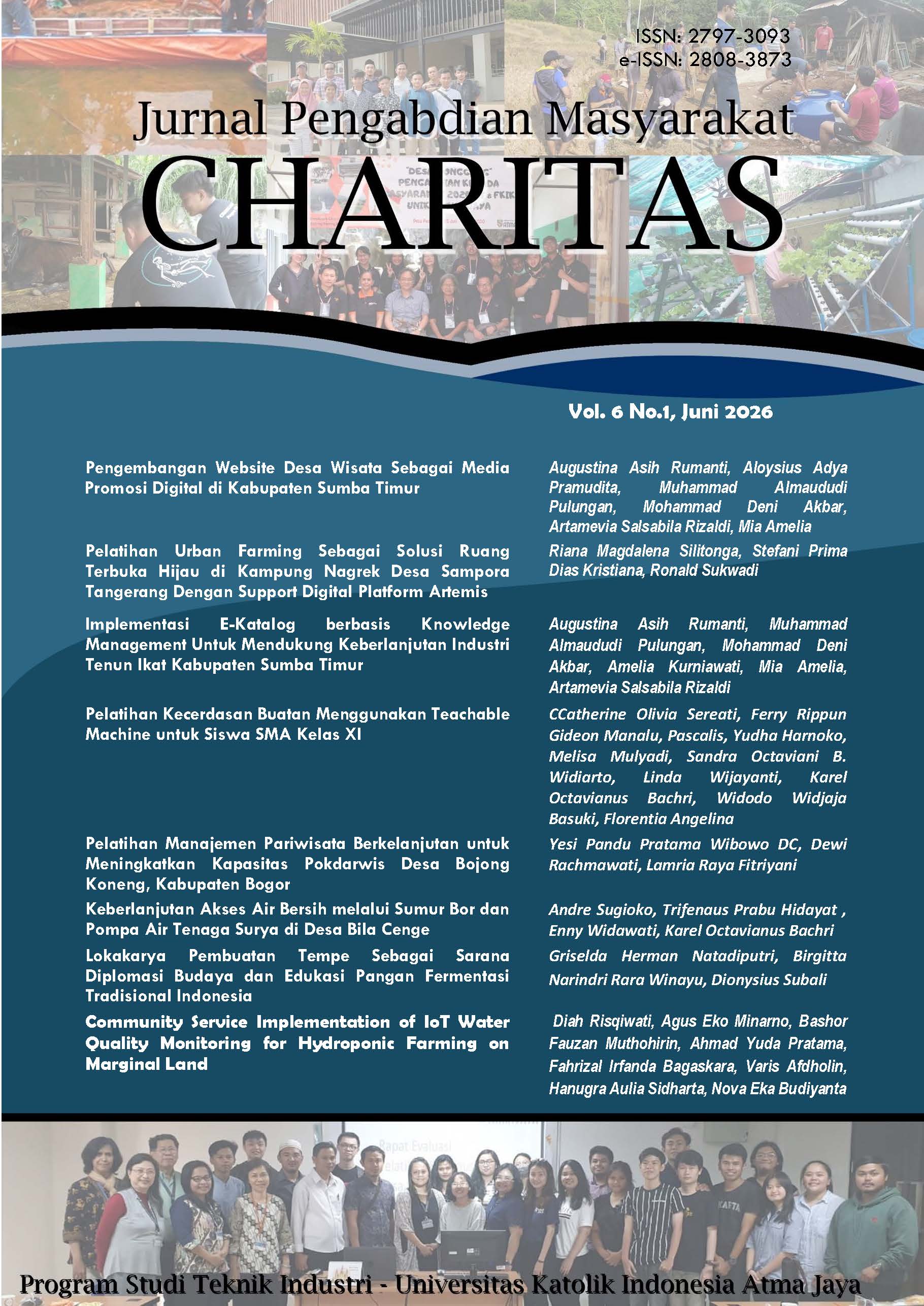
Lokakarya Pembuatan Tempe Sebagai Sarana Diplomasi Budaya dan Edukasi Pangan Fermentasi Tradisional Indonesia
DOI:
https://doi.org/10.25170/charitas.v6i01.8005Kata Kunci:
Tempeh , Workshop, Experiential LearningAbstrak
Tempeh, a traditional Indonesian fermented food, has been acknowledged for its high nutritional value. Besides, production of tempeh can be a potential practice-based educational medium. However, knowledge on tempeh fermentation remains limited, particularly among international participants. This study was aimed to implement a community engagement activity for fermented food education strategy through a tempeh-making workshop and to evaluate the improvement in knowledge and practical skills of international short-course participants. The program was conducted offline using interactive lectures, demonstrations, and hands-on practice sessions. Evaluation was performed using pre-test and post-test assessments along with direct observation during the activities. The results indicated a significant improvement in participants’ understanding of fermentation processes, microbial roles, and tempeh production stages. In addition, participants demonstrated enhanced practical skills and increased interest in further exploration of fermented foods. The activity also contributed to introducing tempeh as part of Indonesia’s culinary heritage to an international audience. Therefore, the tempeh workshop can serve as an effective educational strategy to enhance fermented food literacy while supporting food-based cultural diplomacy.
Referensi
Askren, J., & James, W. (2021). Experiential learning methods in culinary course can bridge the gap: Student perceptions on how hands-on curriculum prepares them for industry. Journal of Hospitality & Tourism Education, 33, 111 – 125. https://doi.org/10.1080/10963758.2020.1791134.
Barus, T., & Hutagalung, R. A. (2024). Pelatihan pembuatan tempe yang higienis untuk penyediaan pangan sehat masyarakat Kampung Cibelut Cisauk-Tangerang. Abdimas Galuh, 6(2), 1123 – 1135. http://dx.doi.org/10.25157/ag.v6i2.14303.
Fevria, R., Vauzia, V., Putri, D. H., Achyar, A., Putri, S. D., & Edwin, E. (2024). Isolation and identification of lactic acid bacteria using PCR gene from tempe wrapped with banana leaves and plastic. Indonesian Food Science and Technology Journal, 7, 127 – 132. https://doi.org/10.22437/ifstj.v7i2.32503.
Hu, M. L., & Chen, K. T. (2025). Research on sustainable food literacy education talent cultivation. Sustainability, 17, 7172. https://doi.org/10.3390/su17167172.
Kolb, D. A. (2014). Experiential Learning: Experience as the Source of Learning and Development (2nd ed.). Upper Saddle River (NJ): Pearson Education.
Menon, S., & Suresh, M. (2020). Synergizing education, research, campus operations, and community engagements towards sustainability in higher education: A literature review. International Journal of Sustainability in Higher Education, 21, 1015 – 1051. https://doi.org/10.1108/IJSHE-03-2020-0089.
Pole, K., & McGee, M. (2025). Experiential learning. Dalam Wang, S., Zhou, Z., & Marginson, S. (Eds.), Teaching and Learning in Higher Education (pp. 51 – 63). Singapore: Springer Nature Singapore.
Prativi, M. B., Astuti, D. I., Putri, S. P., Laviña, W. A., Fukusaki, E., & Aditiawati, P. (2023). Metabolite changes in Indonesian tempe production from raw soybeans to over-fermented tempe. Metabolites, 13, 300. https://doi.org/10.3390/metabo13020300.
Riyanto, R. A., Fukusaki, E., & Putri, S. P. (2024). Metabolite profiling highlights the effect of microbial intervention in the soaking step of tempe. International Journal of Food Science and Technology, 59, 7414 – 7425. https://doi.org/10.1111/ijfs.17481.
Saputra, I. W. A. R., Susanti, L. E., & Arianti, A. A. A. A. S. (2024). Pemanfaatan tempe sebagai komoditi lokal untuk pasar global. Segawati Jurnal Pengabdian Masyarakat, 3(2), 73-78. https://doi.org/10.59819/sewagati.v3i2.4260.
Tamang, J. P., Cotter, P. D., Endo, A., Han, N. S., Kort, R., Liu, S. Q., Mayo, B., Westerik, N., & Hutkins, R. (2020). Fermented foods in a global age: East meets West. Comprehensive Reviews in Food Science and Food Safety, 19, 184 – 217. https://doi.org/10.1111/1541-4337.12520.
Teoh, S. Q., Chin, N. L., Chong, C. W., Ripen, A. M., How, S., & Lim, J. J. L. (2024). A review on health benefits and processing of tempeh with outlines on its functional microbes. Future Foods, 9, 100330. https://doi.org/10.1016/j.fufo.2024.100330.
Van Eeden, E., Eloff, I., & Dippenaar, H. (2021). On responses of higher education and training with(in) society through research, teaching, and community engagement. Educational Research for Social Change, 10(1), 1-15. https://doi.org/10.17159/2221-4070/2021/v10i1a1.