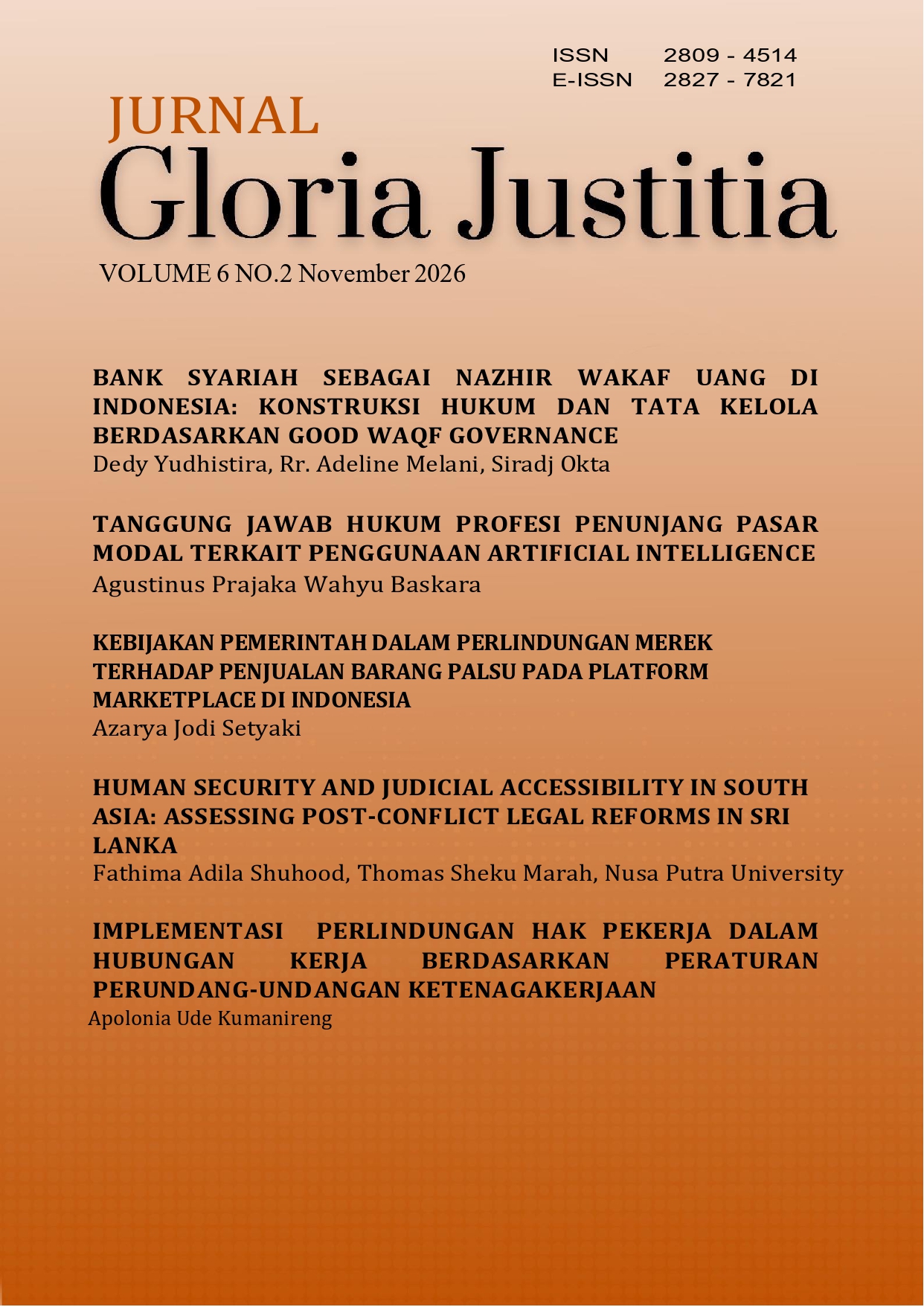
HUMAN SECURITY AND JUDICIAL ACCESSIBILITY IN SOUTH ASIA: ASSESSING POST-CONFLICT LEGAL REFORMS IN SRI LANKA
DOI:
https://doi.org/10.25170/gloriajustitia.v6i2.7539Keywords:
Human Security, Judicial Reform, Acces to Justice, Sri Lanka, Transitional JusticeAbstract
Abstract
Post-conflict societies need to rebuild both their justice systems and their citizens' trust in state institutions. For Sri Lanka, where decades of civil conflict have been a predominant influence on governance and civil relationships, judicial reform is central to the retention of human security and the advancement of the rule of law. This study seeks to understand the impact of post-conflict judicial reform on access to justice, accountability, and trust in institutions in Sri Lanka. This will help assess the value of legal modernization in human security, particularly in the dimensions of safety, dignity, and equality before the law. Drawing on the Human Security Framework and the Theory of Transitional Justice, the study is qualitatively doctrinal and case-based. Judicial reform policies, human rights commission reports, and a selection of case studies from the years 2009–2024 comprise the sources of data. Each of the three dimensions of institutional independence, the rights of vulnerable persons, and the civic aspect of the justice system was part of the thematic analysis. This study found that Sri Lanka has legalized the receipt of judicial services and has provided more access to legal aid. However, the need to guarantee active neutrality and provide timely resources, victim aid, and accountability for abuse of power within the bridge of civil relationships remains. The research indicates that the incorporation of human security principles into national strategies regarding the judiciary can further reconciliation, strengthen the legitimacy of institutions, and achieve durable peace.
References
References
Amnesty International. Sri Lanka: Routine Torture in Police Custody. London: Amnesty International, 2017.
———. Locked Away: Torture and Detention in Sri Lanka. London: Amnesty International, 2022.
Asia Foundation. Sri Lanka: Strengthening the Rule of Law and Access to Justice. Colombo: The Asia Foundation, 2020.
Centre for Policy Alternatives. A Brief Guide to the Twentieth Amendment. Colombo: CPA, 2020.
———. Digitizing the Courts: Opportunities and Limitations. Colombo: CPA, 2021.
Centre for Human Rights and Development. Barriers to Justice for Vulnerable Communities in Sri Lanka. Colombo: CHRD, 2021.
De Mel, Neloufer. Reconciliation and Transitional Justice in Sri Lanka. Colombo: International Centre for Ethnic Studies, 2021.
Fonseka, Bhavani, and L. Jegatheeswaran. Post-War Justice in Sri Lanka: Rule of Law, the Military and Politics. Colombo: Centre for Policy Alternatives, 2019.
Government of Sri Lanka. The Nineteenth Amendment to the Constitution. Colombo: Government Printer, 2015.
Human Rights Commission of Sri Lanka (HRCSL). Annual Report 2010. Colombo: HRCSL, 2011.
———. Annual Report 2013. Colombo: HRCSL, 2014.
———. Annual Report 2016. Colombo: HRCSL, 2017.
———. Annual Report 2018. Colombo: HRCSL, 2019.
———. Annual Report 2019. Colombo: HRCSL, 2020.
———. Annual Report 2020. Colombo: HRCSL, 2021.
———. Annual Report 2021. Colombo: HRCSL, 2022.
———. Annual Report 2022. Colombo: HRCSL, 2023.
———. Language Rights Monitoring Report 2020. Colombo: HRCSL, 2020.
———. Language Rights Monitoring Report 2021. Colombo: HRCSL, 2021.
Human Rights Watch (HRW). In the Name of National Security: Abuses Under the PTA. New York: HRW, 2022.
———. Impunity in Sri Lanka: Continuing Challenges. New York: HRW, 2021.
———. “We Are Not the Enemy”: Police Abuses Against Minorities in Sri Lanka. New York: HRW, 2018.
International Commission of Jurists (ICJ). Authority Without Accountability: The Crisis of Impunity in Sri Lanka. Geneva: ICJ, 2012.
———. Authority Without Accountability: The Crisis of Impunity in Sri Lanka. Geneva: ICJ, 2019.
———. Transitional Justice and the Role of Courts in Sri Lanka. Geneva: ICJ, 2020.
———. Challenges in Victim and Witness Protection in Sri Lanka. Geneva: ICJ, 2020.
International Crisis Group. Sri Lanka’s Transition to Stability. Brussels: International Crisis Group, 2019.
Legal Aid Commission of Sri Lanka. Annual Performance Report 2019. Colombo: LAC, 2019.
———. Annual Performance Report 2020. Colombo: LAC, 2020.
Ministry of Justice. Progress Review on the Victim and Witness Protection Act. Colombo: Ministry of Justice, 2019.
Office on Missing Persons (OMP). First Interim Report. Colombo: OMP, 2018.
———. Progress Report 2018. Colombo: OMP, 2019.
———. Progress Report 2020. Colombo: OMP, 2021.
———. Progress Report 2023. Colombo: OMP, 2024.
Office for Reparations. Annual Progress Review. Colombo: Office for Reparations, 2021.
Office of the High Commissioner for Human Rights (OHCHR). Sri Lanka: Promoting Accountability and Transitional Justice. Geneva: OHCHR, 2015.
———. Report on Transitional Justice and Accountability in Sri Lanka. Geneva: OHCHR, 2021.
———. Sri Lanka: Report on Accountability and Justice. Geneva: OHCHR, 2021.
Peiris, G. L. The Sri Lankan Legal System: Historical Development and Institutional Challenges. Colombo: Lake House Press, 2017.
Supreme Court of Sri Lanka. SC FR Applications (various cases, 2010–2023).
———. Circular on Virtual Court Proceedings. Colombo: Supreme Court, 2020.
Transparency International Sri Lanka. Judicial Integrity and Anti-Corruption Assessment. Colombo: TISL, 2019.
UNICEF Sri Lanka. Child Protection Systems Review. Colombo: UNICEF, 2022.
United Nations Development Programme (UNDP). Access to Justice in Sri Lanka: National Assessment. New York: UNDP, 2018.
———. Human Security Framework. New York: UNDP, 2016.
Uyangoda, Jayadeva. Politics of Justice in Post-War Sri Lanka. Colombo: Social Scientists’ Association, 2020.
Verité Research. The Cost of Delays in Sri Lanka’s Courts. Colombo: Verité Research, 2020.
Women and Media Collective. Violence Against Women in Sri Lanka: Trends and Responses. Colombo: WMC, 2021.
———. Access to Justice for Women in Post-War Sri Lanka. Colombo: WMC, 2020.
Downloads
Published
Issue
Section
License
Copyright (c) 2026 Fathima Adila Shuhood, Mr Thomas Sheku Marah

This work is licensed under a Creative Commons Attribution-ShareAlike 4.0 International License.
You are free to:
- Share — copy and redistribute the material in any medium or format for any purpose, even commercially.
- Adapt — remix, transform, and build upon the material for any purpose, even commercially.
- The licensor cannot revoke these freedoms as long as you follow the license terms.
Under the following terms:
- Attribution — You must give appropriate credit, provide a link to the license, and indicate if changes were made. You may do so in any reasonable manner, but not in any way that suggests the licensor endorses you or your use.
- ShareAlike — If you remix, transform, or build upon the material, you must distribute your contributions under the same license as the original.
- No additional restrictions — You may not apply legal terms or technological measures that legally restrict others from doing anything the license permits.
Notices:
You do not have to comply with the license for elements of the material in the public domain or where your use is permitted by an applicable exception or limitation.
No warranties are given. The license may not give you all of the permissions necessary for your intended use. For example, other rights such as publicity, privacy, or moral rights may limit how you use the material.