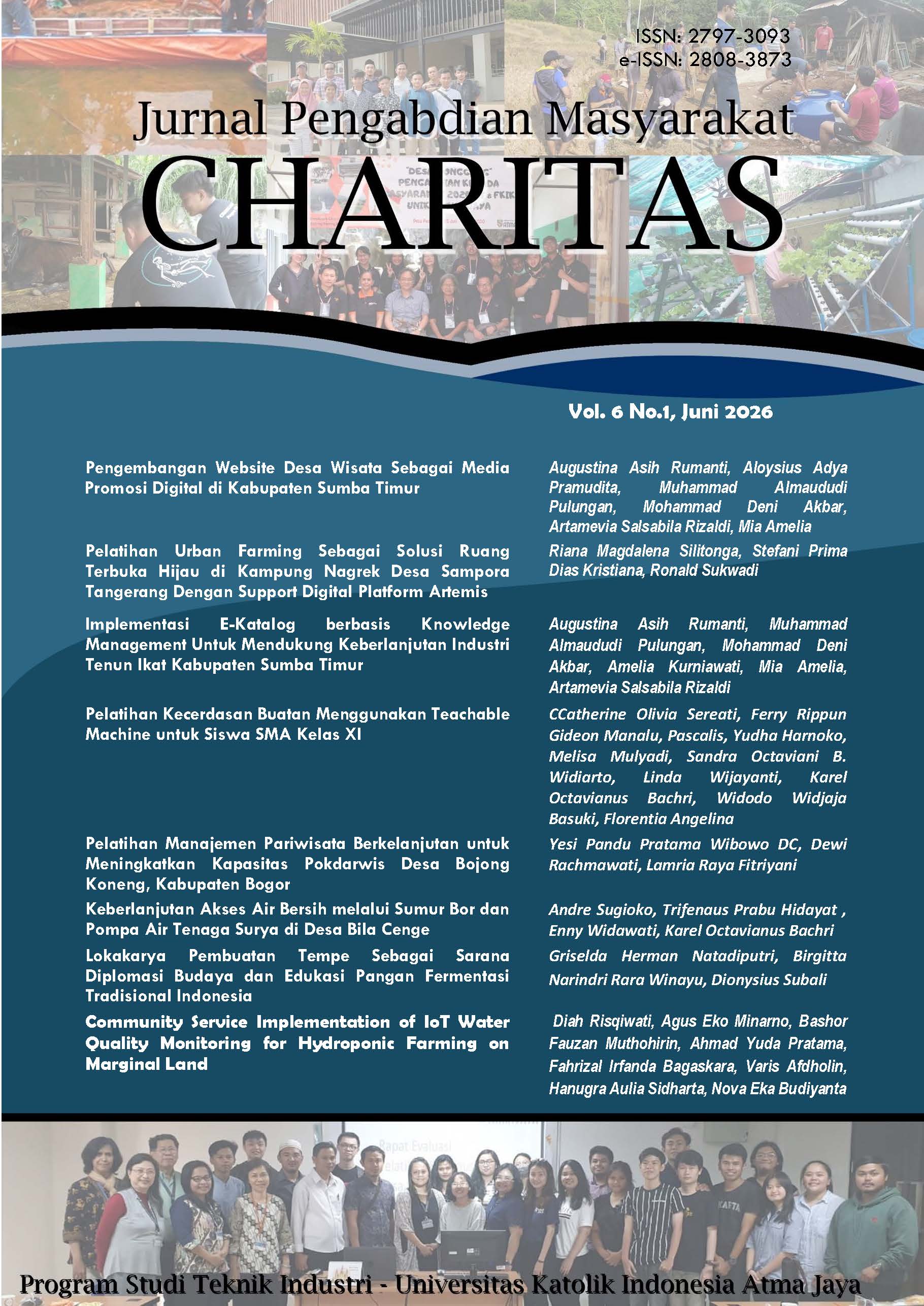
Pelatihan Urban Farming Sebagai Solusi Ruang Terbuka Hijau di Kampung Nagrek Desa Sampora Tangerang Dengan Support Digital Platform Artemis
DOI:
https://doi.org/10.25170/charitas.v6i01.7276Kata Kunci:
Artemis, Solid Settlements, Green Open Space, Urban FarmingAbstrak
Tangerang with high population growth coupled with rapid development often changes the natural configuration of the land to the detriment of the existence of Green Open Space (RTH). The existing Tangerang Regency open green space is only 8% or 80.14 km2. Nagrek village, Sampora village, Tangerang was chosen because the area is a dense settlement that lacks green space and has a group of non-productive housewives. Policies that can be carried out to restore environmental conditions and overcome green space issues in Nagrek Village are by implementing an urban farming program with a conventional farming system and a hydroponic axis system by involving non-productive housewives. The method of implementing urban farming training is carried out with 5 stages, namely the stages of preparation, outreach, training, mentoring and evaluation. The recruitment phase of the activity implementation team and the measurement of the results of community service are recorded in the Artemis digital platform. The results of the urban farming training activities in the Nagrek Village Sampora Village Tangerang received a response that Nagrek Village looks more beautiful than before. Many non-participant residents began to be interested in participating in implementing the urban farming program in their own homes.
Referensi
Alaimo, K., Packnett, E., Miles, R., Kruger dan D. (2008). Fruit and Vegetable Intake among Urban Community Gardeners. Journal of Nutrition Education and Behavior, 40 (2);94-101
Despommier, D. (2010). The Vertical Farm: Feeding the World in the 21st Century. New York: Thomas Dunne Books.
Hadi, P. (2016). Konsep Prototype Integrated Verticulture Aquaponic City Farming Di Kampung Batik Surakarta. Seminar Nasional Dies Natalis XXXIII Universitas Islam Batik Surakarta (pp. 131-141). Surakarta, Indonesia, Universitas Islam Batik Surakarta.
Illiyin, D. F. dan H. Idajati. (2015). Faktor-Faktor Yang Mempengaruhi Masyarakat Dalam Penggunaan Ruang Terbuka Publik Sebagi Fungsi Sosial di GOR Delta Sidoarjo Berdasarkan Preferensi Masyarakat. Jurnal Teknik ITS, 4(2), 114-118.
Mougeot, L. J. A. (2006). Growing Better Cities: Urban Agriculture for Sustainable Development. Ottawa: International Development Research Centre (IDRC).
Nugroho, A., & Dewi, I. K. (2018). Pemberdayaan Masyarakat Melalui Pertanian Perkotaan (Urban Farming) di Kelurahan Jati, Kecamatan Padang Timur, Kota Padang. Jurnal Ilmiah Pengabdian kepada Masyarakat, 2(2), 95-102.
Peraturan Menteri Pekerjaan Umum Nomor 05/PRT/M/2008. Pedoman Penyediaan dan Pemanfaatan Ruang Terbuka Hijau Di Kawasan Perkotaan. Dirjen Tata Ruang-Departemen PU. Jakarta.
Resh, H. M. (2013). Hydroponic Food Production: A Definitive Guidebook for the Advanced Home Gardener and the Commercial Hydroponic Grower (7th ed.). Boca Raton: CRC Press.
Sanyé-Mengual, E., Orsini, F., & Gianquinto, G. (2018). Sustainability Assessment of Urban Rooftop Farming Using an Interdisciplinary Approach. Biosystems Engineering, 177, 190-202.
Tangerangnews.com, 2010. Tangerang Sangat Minim Ruang Terbuka Hijau. http://www.tangerangnews.com/kotatangerang/read/3489/Tangerang-Sangat-Minim-Ruang-Terbuka-Hijau. Diakses tanggal 16 Desember 2019
Viljoen, A., & Bohn, K. (Eds.). (2014). Second Nature Urban Agriculture: Designing Productive Cities. Routledge.
WinklerPrins, A. M. G. A. (Ed.). (2017). Global Urban Agriculture: Convergence of Theory and Practice. CABI.